Statuette of Anubis
Dating back to the Roman Period (2nd century AD), this bronze statuette of god Anubis was purchased from the Huber Collection. The jackal-headed Anubis is one of immortal gods in the ancient Egyptian mythology whose importance is attributed to his great role in the underworld as the protector of the dead bodies. One of the commonest funeral scenes depict the god bending over the deceased's body and performing the processes of mummifications. Depending on the realization that every thing after death came to life again, the Ancient Egyptians hold the belief that there is a life after death. Based on these beliefs, they held to the idea that a new life began after a person died, a supposition that made the idea of mummification of dead bodies inevitable.
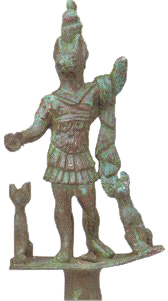
This statue witnesses the religious syncretism that extended from the Ptolemaic Era to the Roman Era. This entailed a blending of two or more religious belief systems into a new system, or the incorporation into a religious tradition of beliefs from unrelated traditions. Here, Anubis is pictured as a dog-headed man with a double crown over his head. Two dogs are posing on either side of the god. Dresses in the Roman style, he holds a long cloak with his left arm.
Facts
- Material: Bronze
- Size: height 14.8 cm, width 6.5 cm
- Period: Roman Period
- Museum: Egyptian Museum, Cairo
Related

Registration successfull!

Your Registration is successfully done
Please Check Your E-mail to Confirm Your Account. Do not forget to open the spam folder.
 EUR


 Español
 English
 العربيه


