Mask of Ammonarin
This highly artistic funerary mask of a woman called Ammonarin was found in1888 by W.M.F. Petrie in Hawara, a very famous archeological site near the Fayoum Oasis. A great corpus of plaster masks was made during the Roman imperial era. The Roman taste had a particular interest in making portraits and masks that stand for iconographic realism. Such a tendency became the most successful expression of the reciprocal penetration of Egyptian and Roman cultures that were far more integrated in death than in life. While plaster masks were placed on the mummy over the area of the face, portraits were either placed among the bandages wrapping the deceased's mummy or on the linen shrouds.
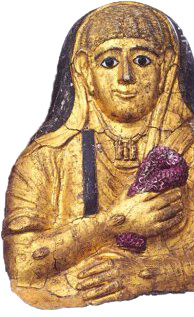
Dating back to the Roman Period, to the reign of Emperor Claudius (41-54 AD), this highly admired mask of Ammonarin which covers both her head and bust is made of cartonnage and cloth mixed with gilded and painted stucco. The name of the woman is inscribed in gold on the back of her head. Similar in style to the traditional Egyptian funerary masks, this example of funerary masks denotes a high taste of decoration and a skillfully-organized color arrangement. Realistically portrayed, the beauty of the eyes is gracefully highlighted by eye black. Worth noticing is the slight smile that lightens the mask's face. With her right hand, she holds a bunch of violet flowers. Hanging from her neck is a fine highly artistic gold necklace. There are three figures hanging down from this necklace: the one in the middle is depicted naked (and therefore possibly identified as Harpocrates, the god of silence in the Greek mythology).
Facts
- Material: Cartonnage, Cloth, & Gilded and Painted Stucco
- Size: height 51 cm, width 41 cm
- Found in: Hawara , Near the Fayoum Oasis, 1888
- Discovered by: W.m.f. Petrie
- Belonged to: Ammonarin
- Reign of: Claudio
- Period: Roman Period
- Museum: Egyptian Museum, Cairo
Related

Registration successfull!

Your Registration is successfully done
Please Check Your E-mail to Confirm Your Account. Do not forget to open the spam folder.
 EUR


 Español
 English
 العربيه


