Portrait of Two Brothers
Found in Antinoopolis by M. Gayet, this portrait of a young man dates back to the Roman Period (2nd century AD). A great corpus of portraits painted on wood known as the "Fayum portraits" was made during the Roman imperial era. The Roman taste had a particular interest in making portraits that stand for iconographic realism. Such a tendency became the most successful expression of the reciprocal penetration of Egyptian and Roman cultures that were far more integrated in death than in life. Portraits were either placed among the bandages wrapping the deceased's mummy or on the linen shrouds.
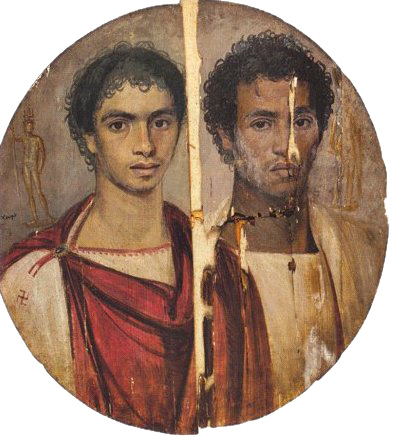
This example of the Fayum encaustic paintings made on wood depicts two brothers. The panel is a witness on this significant phase in the history of Egypt. Mixed marriages among the Egyptians and Romans and Greeks were prevailing. This explains the apparent differences in the outer physical characteristics of the two figures.
The dark-toned man on the right has impressive Negroid facial expressions on his face. He is depicted wearing a white garment, with densely clustered black hair ringlets with a shaved beard and a thin-lined moustache over his fleshy mouth. Most impressive is the look he gives, which shows a great dissatisfied gaze the viewer first notices.
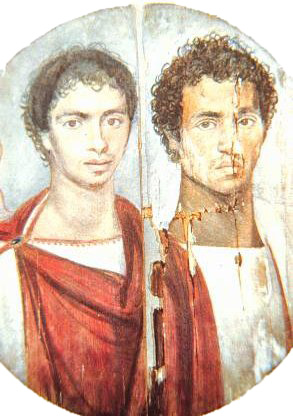
The man on the left, on the other hand, wears more elegant and elaborate dress decorated with embroidery. A fine clasp fastens the red scarf with the white cloak. Unlike his brother, this man wears a more innocent expression on his childlike face.
Above each of the two brothers, there is a depiction of a god. The deity depicted holding a wand and wearing winged sandals is god Mercury, the Roman equivalent for the Greek god Hermes. The other god appears wearing a triple wig with a crown of rays over his head.
Facts
- Material: Encaustic Painting on Wood
- Size: diameter 61 cm
- Found in: Antinoopolis, 1899
- Discovered by: M. Gayet
- Period: Roman Period
- Museum: Egyptian Museum, Cairo

Registration successfull!

Your Registration is successfully done
Please Check Your E-mail to Confirm Your Account. Do not forget to open the spam folder.
 EUR


 Español
 English
 العربيه


