Portrait of a Man (Encaustic Painting on Wood)
This portrait of a man dates back to the Roman Period (first half of the 2nd century AD). A great corpus of portraits painted on wood known as the "Fayum portraits" and plaster masks was made during the Roman imperial era. The Roman taste had a particular interest in making portraits that stand for iconographic realism. Such a tendency became the most successful expression of the reciprocal penetration of Egyptian and Roman cultures that were far more integrated in death than in life. While plaster masks were placed on the mummy over the area of the face, portraits were either placed among the bandages wrapping the deceased's mummy or on the linen shrouds.
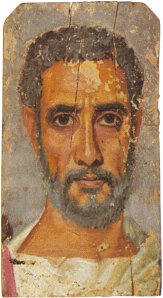
This example of the Fayum portraits is an encaustic painting skillfully made on wood. With delicate tones, the sad expression on the middle-aged man's face is suggested by the thick slightly-curved dark eyebrows and the large faint eyes. The downhearted gaze is faithful to the sadness the man feels for meeting death at this age. The face is framed with the heavy grey hair with short curls over the head as well as the trimmed beard and mustache. The man is dressed in a white garment. Like other Fayum portraits, there is a great interest in employing the contrast of lights and colors.
Facts
- Material: Encaustic Painting on Wood
- Size: height 34 cm, width 18.5 cm
- Period: Roman Period
- Museum: Egyptian Museum, Cairo

Registration successfull!

Your Registration is successfully done
Please Check Your E-mail to Confirm Your Account. Do not forget to open the spam folder.
 EUR


 Español
 English
 العربيه


