Portrait of a Woman (Hawara , Near Fayum Oasis)
Found in Hawara by W.M.F. PETRIE, this portrait of a young woman dates back to the Roman Period (late 1st century AD). At this site, the panels were made of cedar and were more slender to be placed easily among the bandages wrapping the deceased's body. A great corpus of portraits painted on wood known as the "Fayum portraits" was made during the Roman imperial era. The Roman taste had a particular interest in making portraits that stand for iconographic realism. Such a tendency became the most successful expression of the reciprocal penetration of Egyptian and Roman cultures that were far more integrated in death than in life. Portraits were either placed among the bandages wrapping the deceased's mummy or on the linen shrouds.
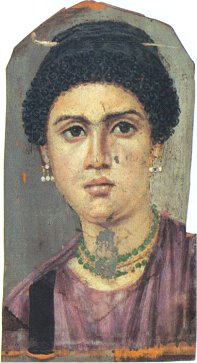
Found in 1888, this example of the Fayum encaustic paintings made on wood depicts a young woman called Demos, said to meet death at the age of twenty four during the reign of Emperor Domitian (81-96 AD). Archeologists were able to know the lady's identity from some informative carvings they discovered on a piece of cloth found near the woman's bust. She gives a serious, severe, and dissatisfied gaze with her eyes. She wears a violet tunic with delicate tones. The hairstyle appears typically faithful to that one prevailing at that period. Worth admiring is the woman's hair which is simply fastened with a gilded pin. Highly admired is the fine green necklace of emeralds and gold with three strings hanging down from her long smooth neck. She also wears a pair of earrings from which pearls freely dangle.
Facts
- Material: Encaustic Painting on Wood
- Size: height 38 cm, width 21 cm
- Found in: Hawara , Near Fayum Oasis, 1888
- Discovered by: W.m.f. Petrie
- Belonged to: Demos
- Period: Roman Period
- Museum: Egyptian Museum, Cairo
Related

Registration successfull!

Your Registration is successfully done
Please Check Your E-mail to Confirm Your Account. Do not forget to open the spam folder.
 EUR


 Español
 English
 العربيه


