Funerary Mask
This highly artistic funerary mask –made of gilded and painted cartonnage– dates back to the early Roman Period (1st century AD). A great corpus of portraits painted on wood known as the "Fayum portraits" and plaster masks was made during the Roman imperial era. The Roman taste had a particular interest in making portraits that stand for iconographic realism. Such a tendency became the most successful expression of the reciprocal penetration of Egyptian and Roman cultures that were far more integrated in death than in life. While plaster masks were placed on the mummy over the area of the face, portraits were either placed among the bandages wrapping the deceased's mummy or on the linen shrouds.
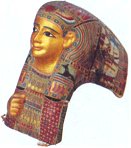
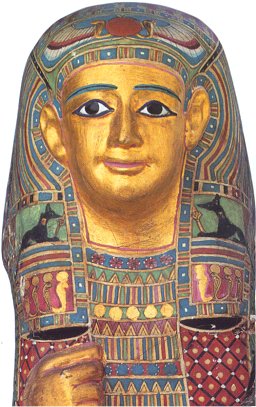
Similar in style to the traditional Egyptian funerary masks, this example of funerary masks denotes a high taste of decoration and a skillfully-organized color arrangement. Decorating the mask are geometrical and botanical patterns with symmetrical highly artistic colors. The right hand of the mask's owner appears with the fist folded. Two paintings of Anubis, the god of mummification are portrayed on either side of the mask, near the neck holding lotus flowers. Downwards, there is a pair of copra frieze on the two sides, holding the solar disc. Realistically portrayed, the face is framed with a blue thick line crossed with stripes. Both the face and hand are painted gold with the ears sticking out. Worth noticing is the slight smile that lightens the mask's face. The beauty of the eyes is gracefully highlighted by eye black. Also highly admired is the winged solar disc flanked by two cobras in the center of the head.
Facts
- Material: Cartonnage Gilded and Painted
- Size: height 42 cm, width 26 cm
- Period: Roman Period
- Museum: Egyptian Museum, Cairo

Registration successfull!

Your Registration is successfully done
Please Check Your E-mail to Confirm Your Account. Do not forget to open the spam folder.
 EUR


 Español
 English
 العربيه


