Portrait of a Young Boy
Found in Fayum, this portrait of a young boy dates back to the Roman Period (1st century AD). A great corpus of portraits painted on wood known as the "Fayum portraits" and plaster masks was made during the Roman imperial era. The Roman taste had a particular interest in making portraits that stand for iconographic realism. Such a tendency became the most successful expression of the reciprocal penetration of Egyptian and Roman cultures that were far more integrated in death than in life. While plaster masks were placed on the mummy over the area of the face, portraits were either placed among the bandages wrapping the deceased's mummy or on the linen shrouds.
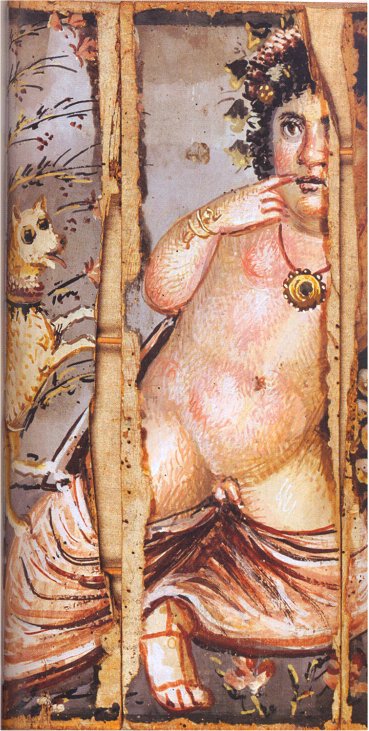
This panel, masterly painted on wood, is one of the masterpieces of the Fayoum portraits in which every single detail tells it all. The perfectly handled light contrast and the chromatic effect add to the beauty of the painting. The portrait pictures a young naked baby boy leaning against a wall with his legs slightly flexed and his finger on his mouth. The child is shown with the same posture of Harpocrates, the god of silence adapted by the Greeks from the Egyptian child god Horus. A scarf is freely wrapped down the boy's tights and legs. On his feet the child wears a fine sandal of high taste, typical to the style prevailing at that time. Hanging down from his neck is a fine round golden pectoral decorated with beads of different sizes. A golden bracelet circulates the boy's right hand. The brush of rosy color on the body renders the portrait livelier. To the left appears a dog in play: it is shown posing on its rear legs with its tongue getting out, which indicates the vigorous state both of the two figures are distinct with. Most admired is the multi-colored laurel wreath topping the boy's head.
Facts
- Material: Painted Wood
- Size: height 37 cm
- Found in: Fayum
- Period: Roman Period
- Museum: Egyptian Museum, Cairo
Related

Registration successfull!

Your Registration is successfully done
Please Check Your E-mail to Confirm Your Account. Do not forget to open the spam folder.
 EUR


 Español
 English
 العربيه


