Portrait of a Woman (No. 561)
Discovered in Hawara (near Fayoum Oasis) by W.M.F. Petrie (1888-1889), this portrait of a woman dates back to the Roman Period (mid-1st century AD), during the time of Emperor Flavians. A great corpus of portraits painted on wood known as the "Fayum portraits" was made during the Roman imperial era. The Roman taste had a particular interest in making portraits that stand for iconographic realism. Such a tendency became the most successful expression of the reciprocal penetration of Egyptian and Roman cultures that were far more integrated in death than in life. Portraits were either placed among the bandages wrapping the deceased's mummy or on the linen shrouds.
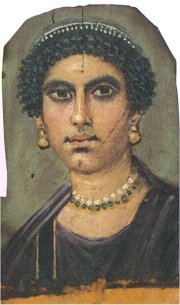
This example of the Fayum encaustic paintings made on wood of fine quality depicts a woman wearing a violet tunic. She has a long neck, a fleshy round face, a graceful dimple down her chin, large expressive eyes, and thick curved eyebrows. Hanging down from her smooth neck are two necklaces of pearls and emeralds. She wears a pair of fine gold spherical earrings that adds much to her beauty. Over her head, she wears a crown of fine taste decorated with small beads, which provide more light contrast at her head.
Facts
- Material: Encaustic Painting on Wood
- Size: height 35 cm, width 21.5 cm
- Found in: Hawara , Near Fayum Oasis, 1888-1889
- Discovered by: W.m.f. Petrie
- Period: Roman Period
- Museum: Egyptian Museum, Cairo
Related

Registration successfull!

Your Registration is successfully done
Please Check Your E-mail to Confirm Your Account. Do not forget to open the spam folder.
 EUR


 Español
 English
 العربيه


