The French Occupation of Egypt (1799-1802)

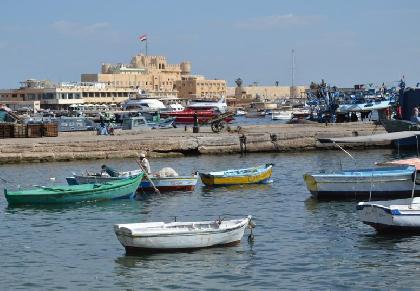
The armies of Napoleon Bonaparte defeated the Mameluke army at Imbabah and Shubra Khit; took Alexandria; and occupied Cairo . In fact , Napoleon wanted to strike a blow to the British Empire , with which France was at war in order to gain control over land and sea routes to the British colony of India . Within a month of entering Egypt , the British navy , under Admiral Nelson , attacked and destroyed the French fleet at Abu Qir Bay in Alexandria .
The Ottoman Sultan Selim III sent an army that , although it was defeated by the French , made it clear they were not in Egypt with the complicity of Constantinople . The people of Cairo rioted against the French . Centered on Al Azhar mosque and led by the 'ulama' (high respected religious figures) , the rebellion had a religious as well as a national character . During this period , the populace began to regard the ulama not only as moral but also as political leaders . By that time , the French general Dupuy was killed . Bonaparte and General Jean Baptiste Kléber quickly suppressed this rising; but the stabling of the French cavalry in the mosque of Al-Azhar gave great and permanent offence . In 1799 , Napoleon succeeded in invading Syria but failed in taking Acre (in Palestine) and his forces retreated . During Bonaparte's absence from Egypt , Murad Bey and Ibrahim Bey made an attempt to attack Cairo , but he arrived in time and inflicted a crushing defeat on the Turkish army that had landed at Abu Qir , aided by the British fleet that was commanded by Sir Sidney Smith .
Few months later , Napoleon , with a very small company , secretly left Egypt to France , leaving his troops behind and General Jean-Baptiste Kléber as his successor . General Kléber was assassinated , leaving the army to General Menou , who claimed to have converted to Islam and declared Egypt a French protectorate . The occupation was finally terminated by an Anglo-Ottoman invasion force . The French forces in Cairo surrendered on June 18 , 1801 , and Menou himself surrendered at Alexandria on September 3 . By the end of September , the last French forces had left the country .
Napoleon's invasion revealed the Middle East as an area of immense strategic importance to the European powers , thus inaugurating the Anglo-French rivalry for influence in the region and bringing the British into the Mediterranean . Napoleon established a style of the French government . He implemented public works projects to clean up and renovate the long-neglected country , clearing blocked canals , cleaning the streets and building bridges . He also introduced new crops and a new system of weights and measures . The task of the 167 scholars , scientists and artists who accompanied him was to investigate every aspect of life in ancient and contemporary Egypt . The publication of "Description de l'Egypte" in 24 volumes became the foundation of modern research into the history , society , and economics of Egypt .


Users Comments


Back to -> Modern History of Egypt:
Related geoplaces
-Alexandria
-Mosque of El Azhar

Related Articles


Add your comments
Your name :
Your Email :
I want to receive email if any body write a comment here

Travel offer to Egypt


Choose from our selection of travel offers to Egypt -->

Sightseeing in Egypt


Attractions, monuments, temples, restaurants, museums, sqaures, archelogical sites, and more in Egypt -->

Photo Gallery of Egypt

Visit our photo collection for Egypt , You can also send us photos about Egypt -->

Real Estates in Egypt

Search or advertise for free your home, villa, commercial, office, apartment for sale or rent in Egypt. -->

Forum about Egypt

Participate with friends information, opinions, news, comments, about Egypt. -->

Current Weather in Egypt

Check weather state, dew, wind, cloud and temperature in Egypt -->

Map of Egypt

Map with coordinates, satellite images, zoom, attractions in Egypt -->