| ||
| ||
Pharaoh Amenhotep III
Primarily , the 38-year-reign of Amenhotep III was a period of peace and affluence .
It is probable that Amenhotep III was a child at his accession . It is estimated that his age at accession could have been anywhere between 2 and 12 . A regency by Mutemwiya appears unlikely , but an alternative possibility might be that members of Queen Tiye's family assisted the King in his early rule . A scarab dating back to the second year of Amenhotep III's reign established the early date of his marriage to Tiye , and the identification on another scarab of the Queen's parents , Yuya and Tuya , refers to their prominence . Recent discussions of the reign of Amenhotep III have suggested that he was deified during his lifetime , not only in Nubia , where he built a cult temple for himself , but in Egypt as well . It is arguable that Amenhotep III intended to be identified with the Sun-god from the time of his first jubilee in the 30th or 31st year , since scenes representing that festival show him taking the specific role of Re riding in his solar boat . It is noteworthy that Arnenhotep III named his own palace complex 'the Gleaming Aten' and used stamp seals for commodities that may be read 'Nebmaatre is the Gleaming Aten' . It is now certain that the association of the Aten with Amenhotep III was well established in his own documentation prior to the reign of Amenhotep IV (better known as Akhenaten) . One stela from Amarna shows Amenhotep and Tiye receiving food offerings under the sun-rays of the Aten . While this might be seen to contradict the thesis that Amenhotep III was the Aten , it is perhaps significant that it is made in the late years of Akhenaten's reign . It therefore raises the question as to whether the King and Queen were still alive , or whether the stela , from a private house owner's shrine , venerated the deceased royal couple to invite their intercession . However , there are no stelae or statues that were with certainty dedicated to Amenhotep III as a major deity within Egypt in his lifetime . The deification of Ramses II later on was accompanied by significant number of monuments that identified the god Ramses in a number of cult locations within Egypt . These monuments date from the reign of Ramses himself and do not refer to the King as 'beloved of a certain deity' (as the monuments of Amenhotep III do) . They name Ramses himself as the god and show him being offered to , usually as a statue . Nothing of this type exists for Amenhotep III in Egypt , and the examples that somehow resemble monuments offered to gods can not be safely assigned to the King's lifetime . It is also difficult to ascertain whether Amenhotep III and his son Akhenaten ruled as co-regents for some time . Tiye was the most influential woman of the King's reign and she survived her husband by at least a few years . She was so important to him that she not only appears with him on temple walls at Soleb and West Thebes , accompanying him at the jubilee festivals , but she was deified in her own temple at Sedeinga in Upper Nubia and became part of the royal solar programme . After her husband's death , the king of Mitanni , Tushratta , wrote to Tiye asking her to remind her son Amenhotep IV (Akhenaten) of the close relationship between him and Amenhotep III . Perhaps upon her own death , she was first buried at Amarna , and then moved to either KV 22 or 55 . Tiye gave birth to Satamun , Henuttaneb , Nebetiah , and Isis , all of whom appear on statues and smaller objects , associated with the royal couple . Satamun was the most favored of Tiye's daughters . King Amenhotep III asked for and received a Babylonian princess as wife and he married two Mitannian princesses (one of Taduhepa , having reached Egypt only just in time to become a widow and then married Amenhotep IV) . Amenhotep III had several wives , he also had foreign wives , but whether he had offspring from his foreign ones is unknown . However , there are a number of court women , princes and princesses known by name from funerary objects discovered near Malkata . Some of these may have been royal family members , others were minor wives . Amenhotep III had two sons: one is the son of Queen Tiye who is certainly Amenhotep IV . The other son was the Sem-priest Thutmosis , who may have been older than Amenhotep , but his mother is unknown . The body of a royal woman was found in the cache of mummies in the tomb of Amenhotep II (KV 35) . She has been identified as Queen Tiye on the basis of hair samples matched to strands of the Queen's hair carefully boxed in Tutankhamun's tomb . The certainty of this identification is in question , given that objects in the name of Tiye were found both in KV 22 and in KV 55 . The expedition at KV 22 found elements of a coffin that could belong to a queen , but whether that would be Tiye or Satamun , the daughter whom Amenhotep II took as 'Great Royal Wife' during his reign is unknown . |
Users Contributions
|
Related geoplaces
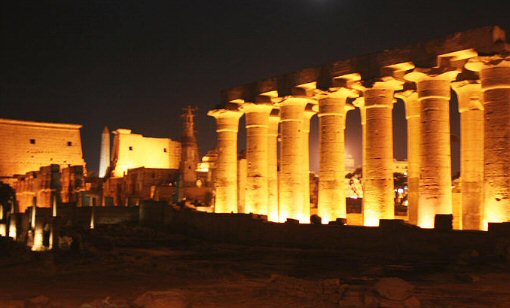
-Luxor Temple
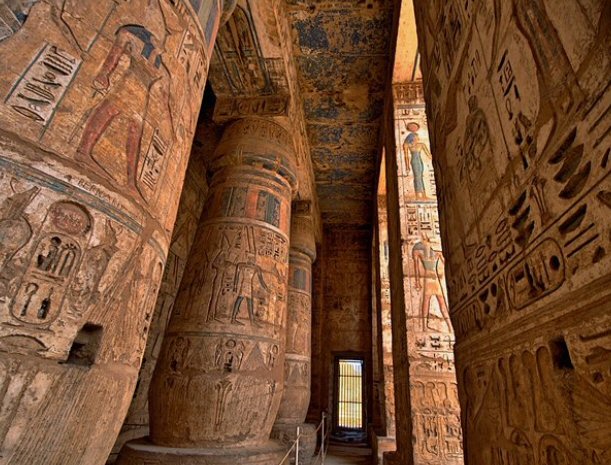
-Temple of Amenhotep III