Stela of Horus on Crocodiles
The statue of Horus on Crocodiles (also known as "Horus Stone") was found at Alexandria in 1880 and was identified to date back to the Ptolemaic Period (circa 305-30 BC). Horus is one of the prominent and most influential gods in the ancient Egyptian mythology and the hero of several myths. He is known as the younger Horus. He played a great role in taking his revenge from his malicious uncle Seth and this qualified him to be the heir of Ra.
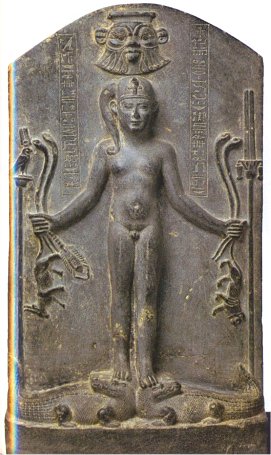
The stela depicts the "god of Earth", Horus, standing triumphantly on two crocodiles, each looking at a side with its tail freely raised. Here, these crocodiles stand for the malicious evil defeated by the god. The child Horus is depicted naked with the standard side braid falling to his shoulder and with a uraeus serpent on his forehead. On his right hands, he carries two snakes, a scorpion, and an oryx; on the left hand, two snakes and a lion. Topping his head is a carving of the head of the god Bes, an ancient Egyptian dwarf god who was a god of protection against evil with his tambourine, harp, or swords. There are two rows of spells in Hieroglyphs probably keeping away the snakes' and scorpions' bites. Near the two (right and left) edges of the stela, there are two long scepters; one carrying an open lotus flower and two feathers and two serpents, the other carrying a crowned falcon. Interestingly this stela – considered similar to the healing statues in its function –was poured with water, then it was drunk by he who needs the god's curable aid.
Facts
- Material: Gray Schist
- Size: height 44 cm, width 26 cm, thickness 11 cm
- Found in: Alexandria, 1880
- Period: Ptolemaic Period
- Museum: Egyptian Museum, Cairo
Related

Registration successfull!

Your Registration is successfully done
Please Check Your E-mail to Confirm Your Account. Do not forget to open the spam folder.
 EUR


 Español
 English
 العربيه


