Scarab
Believed to date back to the Greco-Roman Period (332 BC- 312 AC), this scarab is one of the most common jewels preferred by ancient Egyptians. A great corpus of jewels made from faience, semiprecious stones, and glass paste were found accompanying the deceased in his tomb, especially those with the ability to ward off evil. Resting on a gilded wooden base, this particular scarab is made from glass paste and wood and embellished with gold leaf. The scarab's flat surface is decorated with a hieroglyphic inscription of Chapter 30 of the Book of the Dead.
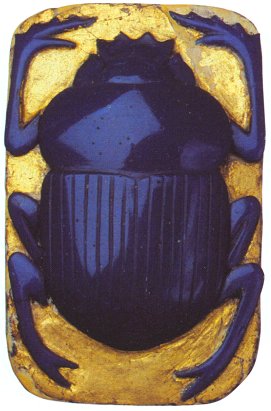
Ancient Egyptians noticed that the female scarab lays its eggs in a ball of dung and rolls it to hide in a safe place. From this they observed new life emerging. Similarly, they believed that Khephri (a gigantic scarab) rolled the sun like a huge ball through the sky, then rolled it through the underworld to the eastern horizon. Each morning Khephri would renew the sun so that it could give life to the entire world. Highly revered and admired, scarabs were used from as early as the Middle Kingdom as seals to protect documents, amphoras, and bolts from being broken open. In addition, The Scarab amulet was one of several amulets dedicated to the Sun God Ra, and was one of the most important of over thirty funerary amulets. The Scarab was known as the "Protector of the Heart", so this amulet was placed in the bandages of mummies or in the mummy’s heart cavity while a priest read an appropriate dedication from the Book of the Dead. They were symbolically identified with the heart of the deceased. A winged scarab might also be placed on the breast of the mummy.
Facts
- Material: Glass Paste, Wood, Gold Leaf
- Size: width 6.5 cm
- Period: Greco-Roman Period
- Museum: Egyptian Museum, Cairo
Related

Registration successfull!

Your Registration is successfully done
Please Check Your E-mail to Confirm Your Account. Do not forget to open the spam folder.
 EUR


 Español
 English
 العربيه


