Stela Dedicated by Ptolemy V to the Bull Buchis
This limestone stela is a good example for the impact of ancient Egyptian style on the Greco-Roman art. It was discovered in the Sacred Bull Cemetery in Aramant in Upper Egypt. The stela consists of three registers and is distinguished by numerous praiseworthy items including the bright colors and the beautiful inscriptions.
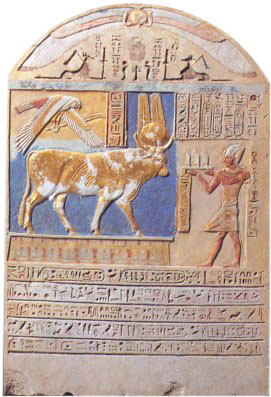
The upper register shows Osiris in his traditional posture as a scarab surrounded by two copra and Anubis in the shape of two jackals by his sides while the winged solar surmounts them at the top of the stela. The brightly colored central register is shows Buchis with a gilded body and a sun disk with two plumes between his horns; the disk and plumes are attributes of Montu, the god of war. Above the bull appears the falcon god Montu with one wing spread over the bull as a sign for protection. The stela portrays the pharaoh Ptolemy V making offering to Buchis and dressed in the traditional style of kings in ancient Egypt. The hieroglyphic inscriptions over the head of the king indicate his name and his wife Cleopatara.
The lower register consists of five lines of Greek inscriptions indicating that the stela was dedicated to the sacred bull that was born in the 11th year of the reign of Amenhotep V rule and died in year 25.
Facts
- Material: Limestone Painted and Gilded
- Size: height 72 CM cm, width 50 CM cm
- Found in: Armant, Bucheum, 1929-1930
- Discovered by: Egypt Exploration Society
- Belonged to: Ptolemy V
- Reign of: Ptolomy V
- Period: The Greco-Roman period
- Museum: Egyptian Museum, Cairo
Related

Registration successfull!

Your Registration is successfully done
Please Check Your E-mail to Confirm Your Account. Do not forget to open the spam folder.
 EUR


 Español
 English
 العربيه


