Shu: God of Air and the Breath of Creation
In ancient Egyptian mythology, Shu was revered as the god of air, a fundamental force in the cosmos. He was a pivotal member of the Ennead of Heliopolis, a group of nine foundational deities, with Ra, the chief sun god, at its head. Shu's name carries the meanings of 'dryness' and 'he who rises up', directly reflecting his domain over the atmosphere and the space above the earth. He was believed to have been created by the primordial god Atum from his own breath, an act that imbued Shu with the very essence of life and separation. Shu was also the brother of Tefnut, the goddess of moisture, and the father of Geb, the god of earth, and Nut, the goddess of the sky, establishing him as a central figure in the divine lineage that shaped the world.]]
The Divine Breath of Atum
Shu's origin from the breath of Atum is a cornerstone of the Heliopolitan creation myth. Atum, the self-created deity, brought Shu into existence through an act often described as spitting or breathing, an action that symbolizes the initial exhalation of life into the void. This primordial breath was not merely a physical act but a divine emanation that gave form to the element of air. Shu's creation, alongside his sister Tefnut, represented the first differentiation of elements from the undifferentiated primeval waters, setting the stage for the subsequent formation of the cosmos.]]
God of Air and Cosmic Order
As the personification of air, Shu held immense significance, representing the very atmosphere that sustains life. His role extended beyond mere existence, as he was believed to have demolished the darkness of the world, transforming it into a suitable place for mortal men and women to live. This act of dispelling darkness underscored his connection to light and the breathable space essential for human habitation. Shu's function was crucial in maintaining the cosmic order, ensuring the separation and balance of the elements.]]
Cosmic Separator and Sustainer
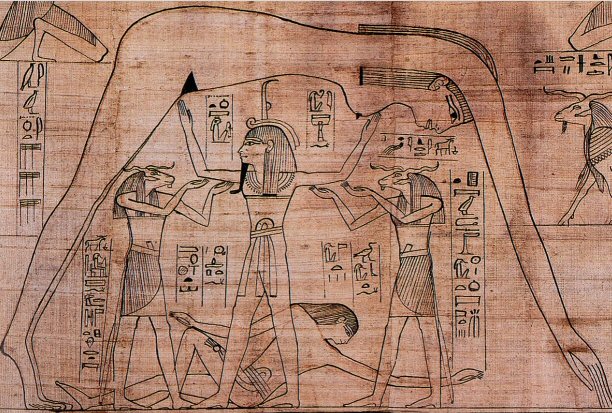
A prominent depiction of Shu shows him supporting his daughter, Nut, the goddess of the sky, with his hands, holding her aloft above her brother and consort, Geb, the god of earth. This iconic image visually represents Shu's vital role in creating the space between the sky and the earth, allowing for the existence of the world as it is known. Without Shu's constant support, the sky and earth would remain intertwined, preventing the cycles of day and night and the emergence of life. His presence ensures the stability and structure of the heavens.]]
Symbolism and Depiction
Shu was typically presented in human form, often distinguished by a large but light ostrich feather adorning his head. This feather was not merely an ornament but a powerful symbol. The ostrich feather is inherently light, perfectly representing the airy nature of Shu, linking Shu to the broader principles of order in the universe. As a companion and assistant to Ra, Shu played an important part in the daily journey of the sun god, further cementing his role in upholding the established cosmic rhythm.]]

Registration successfull!

Your Registration is successfully done
Please Check Your E-mail to Confirm Your Account. Do not forget to open the spam folder.
 EUR


 Español
 English
 العربيه


