Sarcophagus of Khuy
This sarcophagus was found in 1910 in Tomb VIII in Assyut and was identified to date back to the Mid-Twelfth Dynasty. In ancient Egypt, sarcophagi were made out of stone, such as alabaster, granite, or limestone. There are two major functions of the sarcophagus: it was intended to protect the body of the deceased from being destroyed; and was considered the house of eternity where the KA should reside till the afterlife.
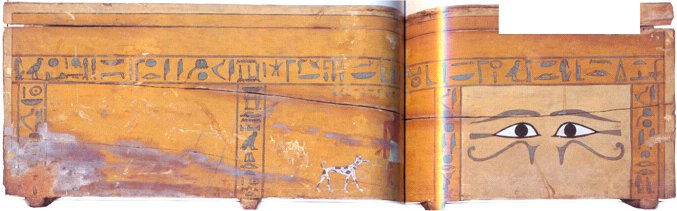
Made from painted wood, this example of sarcophagi belongs to Khuy. The outer sides are ornamented with a long horizontal row of Hieroglyphics supported by a number of vertical ones. Ancient Egyptians thought of the lid of the sarcophagus as the sky, the bottom as the earth and the four sides as the four horizons. The east side of the sarcophagus at the height of the head is decorated with two large Wedjat eyes that symbolize the potential participation of the deceased in the solar cycle; permit the deceased contact with the world of the living and allow the deceased to see. Highly admired is the depiction of the deceased walking his favorite Iupu dog around. Analyzers descried this scene thus: "The touching tenderness of the master towards his faithful canine servant is typical of the spirit of the Middle Kingdom, an age when sentiment frequently prevailed over form, leading to the creation of delightful works of art that are characterized by freshness and immediacy." Although its colors are missed up, this dog is similar to the dogs that can still be seen in Egypt nowadays: it is thin with long legs and a collar on the neck.
Facts
- Material: Painted Wood
- Found in: Assyut, Tomb 8, 1910
- Discovered by: The French Institute of Oriental Archaeology
- Belonged to: Khuy
- Dynasty: 12th Dynasty
- Period: Middle Kingdom
- Museum: Egyptian Museum, Cairo

Registration successfull!

Your Registration is successfully done
Please Check Your E-mail to Confirm Your Account. Do not forget to open the spam folder.
 EUR


 Español
 English
 العربيه


