Model of Weavers at Work
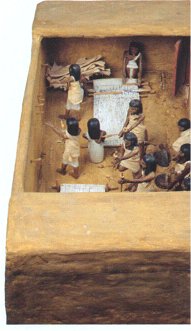
Inside the serdab of the tomb of the notable chancellor Meketra (of early the Twelfth Dynasty) was found a great corpus of realistically-portrayed grave good and miniature models which were skillfully made for the deceased to accompany and serve him/her in the journey in the hereafter. Made from painted wood, one of these models shows a scene of a group of weavers at work. In ancient Egypt, weaving linen and spinning thread were important activities of the household economy. Weavers had to supply the city with fabric not only to make clothes but for other things like canopies for boats. Linen was a very important fabric because it was what most of the Egyptians’ clothes were made from. Weavers produced linen by soaking flax plant stems in water until only fibers were left. Then the fibers were combed into fine strands and spun together making string to weave into linen. The miniature model in question is realistically-portrayed showing a group of female weavers at work in a room whose door is half open. Sitting near two looms placed on the ground, the black-skinned women are shown spinning.
Facts
- Material: Painitd Wood
- Size: height 25 cm, width 42 cm
- Found in: Deir Albahari, Tomb of Meketra, 1919-1920
- Discovered by: The Metropolitan Museum of Art
- Belonged to: Meketra
- Dynasty: 12th Dynasty
- Period: Middle Kingdom
- Museum: Egyptian Museum, Cairo
Related

Registration successfull!

Your Registration is successfully done
Please Check Your E-mail to Confirm Your Account. Do not forget to open the spam folder.
 EUR


 Español
 English
 العربيه


