Figurines of Three Dancing Dwarves
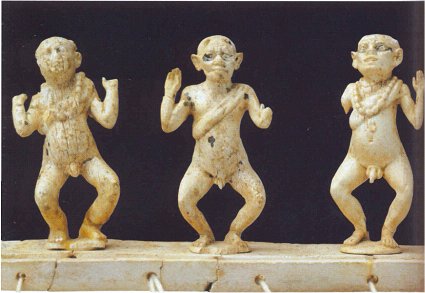
Measuring 7.8 cm in height; 15.8 cm in length; and 4.5 cm in width, this group of realistically-portrayed dancing dwarves was found in the burial chamber of a girl named Hapi, in El List (near Fayoum) and was identified to date back to the Twelfth Dynasty (1994-1781 BC). It was excavated by the Metropolitan Museum of Art in 1934. To the ancient Egyptians, dance was an essential part of their culture. People from every social class were exposed to music and dancing. The laborers worked in rhythmic motion to the sounds of songs and percussion, and street dancers entertained passers by. The function of this ivory item is not yet certain, but it is thought that it may form the upper part of a certain toy. Wearing necklaces made of beads, the three dancing figurines stand on plinths with their legs flexed over a long base. With their hands raised in joy, they are pictured naked with only strings of fabric around their chests. At the end of the base stands the fourth dwarf (now in the Metropolitan Museum) who claps to direct the other three. The strings connected to the base make the figurines rotate if moved.
Facts
- Material: Ivory
- Size: height 7.8 cm, width 4.5 cm
- Found in: Lisht , Near Fayoum Oasis, 1934
- Discovered by: The Metropolitan Museum of Art
- Dynasty: 12th Dynasty
- Period: Middle Kingdom
- Museum: Egyptian Museum, Cairo

Registration successfull!

Your Registration is successfully done
Please Check Your E-mail to Confirm Your Account. Do not forget to open the spam folder.
 EUR


 Español
 English
 العربيه


