Canopic Vases of Inepuhotep
These vases were found in a Middle Kingdom tomb belonging to Inepuhotep and Usermut near the Pyramid of Teti in Saqqara. Dating back to the early Twelfth Dynasty, these roughly finished vases are made of limestone and topped by a lid made of painted wood in the form of a human topped by a black wig. Ancient Egyptians paid much attention to the preservation of the dead body's viscera. The manner of treatment each internal organ of the body received varied according to the Ancient Egyptians' perceptions of their significance. The brain was discarded, because its function was not understood. The heart was considered to be the physical "centre" of the individual and the location of the intelligence. Sometimes the heart was removed and some other times it was deliberately left in place within the chest while other organs were extracted during the mummification. The liver, the lungs, the stomach, and intestines were taken out of the body and washed in a kind of white wine, then placed into canopic containers.
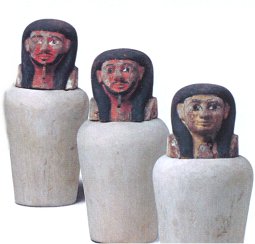
We could identify the owner of these vases from some hieroglyphic inscription on the wooden container that houses the jars, stating the name 'Inepu'. The jars are covered with lids that have images of human heads which are associated with the Four Sons of Horus: the human-headed Amset, the baboon-headed Hapi, the jackal-headed Duamutef, and the falcon-headed Qebehsenuf). These four gods were thought to guard the four organs: the liver, lungs, stomach, and intestines. The heads of these jars are painted in bright colors. Some of the men on the lids have a painted moustache and a false wooden beard.
Facts
- Material: Limestone and Painted Wood
- Size: height 34 cm, diameter 11 cm
- Found in: The Tomb of Inepuhotep and Usermut, to the North of the Pyramid of Teti , Saqqara Necropolis, 1914
- Discovered by: The Egyptian Antlquities Service
- Belonged to: Inepuhotep
- Dynasty: 12th Dynasty
- Period: Middle Kingdom
- Museum: Egyptian Museum, Cairo
Related

Registration successfull!

Your Registration is successfully done
Please Check Your E-mail to Confirm Your Account. Do not forget to open the spam folder.
 EUR


 Español
 English
 العربيه


