Unguentary Belonging Siamun
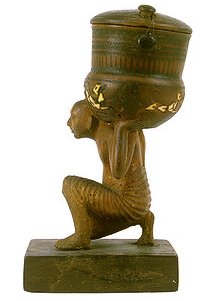
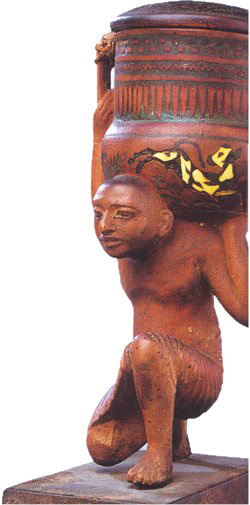
With works of great imagination, ancient Egyptian craftsmen were given the chance to express their creativity through producing highly-artistic items of everyday body care. This anointment holder was discovered in the Tomb of Hatiay who was the observer of the superintendent of the granaries in the temple of Amun. This piece was found within the sarcophagus of one of the three women in his family called Siamun, the "lady of the house." Made of painted wood and ivory, the container tightly closed with a lid of the same material is modeled after the shape of the Syrian large pots. In decoration, the well-preserved piece is ornamented with brown geometric patterns and yellow calves running between trees. The figure supporting the container (supposedly a servant) is magnificently depicted suffering from its heavy weight, an evident feature that exposes great artistic skillfulness and accuracy in details.
Facts
- Material: Painted Wood and Ivory
- Size: height 14 cm
- Found in: Thebes, Qurna, Tomb of Hatiay, 1896
- Discovered by: G. Daressy
- Belonged to: Siamun
- Reign of: Akhenaton
- Dynasty: 18th Dynasty
- Period: New Kingdom
- Museum: Egyptian Museum, Cairo
Related

Registration successfull!

Your Registration is successfully done
Please Check Your E-mail to Confirm Your Account. Do not forget to open the spam folder.
 EUR


 Español
 English
 العربيه


