Mummy of Amenhotep I
This mummy belongs to Pharaoh Amenhotep I, the second king of the Eighteenth Dynasty who met his death in 1504. Depending on the realization that every thing after death came to life again, the Ancient Egyptians hold the belief that there is a life after death and therefore the mummification of dead bodies was inevitable. Notably, mummification symbolizes the fear of the Ancient Egyptians had of death and answers their eager desire for immortality. Such elaborate burial practices of Ancient Egyptians suggest that the Egyptians began early to make plans for their death out of their great love of life.
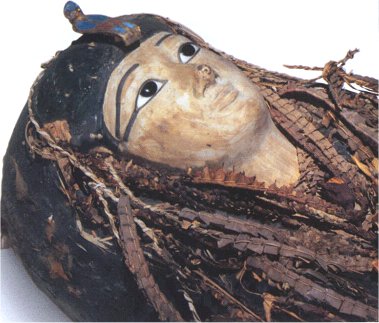
The mummy of Amenhotep I (also known as Amenophis I) was found in the cachette (DB 320) in Deir al Bahari (in Luxor) by the Egyptian Antiquities Service in 1881. There are a number of labels recording the different stages the mummy passed through. It was restored twice: once during the reign of Smendes (of the Twenty-first Dynasty) and the other under the reign of Siamun (the sixth king of the Twenty-first Dynasty). It was Sheshonq I who placed the mummy in the cachette. Most admired is the coffin in which the mummy rests: it is modeled on the life-sized proportions, showing the deceased wearing a dark headdress with a copra at his forehead as symbol of protection against evil influences. Highly artistic are the realistically-portrayed facial features that are masterly highlighted. The beauty of the deceased's face is made more intense by the eye black outlining the eyes.
Facts
- Material: Mummy
- Found in: The Cachette in Deir Al-bahari (db 320), 1881
- Discovered by: The Egyptian Antlquities Service
- Belonged to: Amenhotep I (Amenophis I)
- Reign of: Amenhotep I
- Dynasty: 18th Dynasty
- Period: New Kingdom
- Museum: Egyptian Museum, Cairo
Related

Registration successfull!

Your Registration is successfully done
Please Check Your E-mail to Confirm Your Account. Do not forget to open the spam folder.
 EUR


 Español
 English
 العربيه


