Shawabty Belonging to Lieutenant Hat
This shabti was found in a necropolis in Tuna al Gabal (on the west bank of the Nile opposite Tell al-Amarna) and was identified to date back to the Eighteenth Dynasty, more specifically, to the reign of Amenhotep IV (Akhenaton) (1346-1333 BC). Shawabtis (also Ushabtis) were funerary figurines placed in tombs among the grave goods and intended to act as substitutes for the deceased, should he/she be called upon to do manual labor in the fields of the Land in the afterlife. This is suggested from the name 'usheb' which means 'respond'.
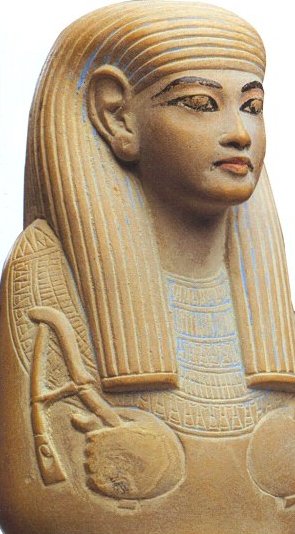
Made from yellow limestone, this figurine belonging to Lieutenant Hat shows great degree of accuracy and high taste. This statuette has red lips, striped triple wig (with blue traces), folded arms, and pierced ears (like all sculpture works of the iconography of Amarna art). The figurine's eyes, eyebrows, and the corners of the mouth are all outlined in black creating a simple but perfect chromatic contrast. It is totally wrapped with bandages leaving the two fists visible, carrying a hoe and a basket. Shawabtis carrying baskets began to appear during the Eighteenth Dynasty and became rare during the Amarna era. Decorating the body of Hat are nine lines of spells and prayers in hieroglyphics of a formula of offerings to Aten on behalf of the Ka of the deceased. Hanging from the smooth neck is a broad shoulder-to-shoulder collar fastened at either side by clasps with heads of Horus.
Facts
- Material: Painted Limestone
- Found in: Tuna El Gabal, 1908
- Belonged to: Hat
- Reign of: Akhenaton
- Dynasty: 18th Dynasty
- Period: New Kingdom
- Museum: Egyptian Museum, Cairo

Registration successfull!

Your Registration is successfully done
Please Check Your E-mail to Confirm Your Account. Do not forget to open the spam folder.
 EUR


 Español
 English
 العربيه


