Sarcophagus of Ahmes Meritamun
This sarcophagus was found in 1929 in the rock-cut Tomb TT 358 in Deir al Bahari, in Luxor. Dating back to the Eighteenth Dynasty during the reign of Amenhotep I (1540-1525 BC), it belongs to Ahmes Meritamon (also spelt Ahmose-Merytamon and Ahmose-Meritamun), whose name means the “Child of the Moon, Beloved of Amun”). She was the remarkable royal daughter of Ahmose I and Ahmose Nefertari, and became the Great Royal Wife of her brother Amenhotep I, the second ruler of the Eighteenth Dynasty.
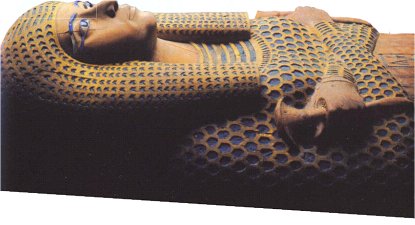
Made from cedar wood, this large anthropoid (mummy-shaped) sarcophagus pictures the image of the beautiful Queen. The body, inlaid with glass paste, is decorated with a long row of Hieroglyphics of the "Hetep-di-nesu Formula" of offerings for the deceased's ka and "Sarcophagus Texts" that runs all the way up to stop at the crossed hands at the chest. Typical to the decorations on sarcophagi in Thebes (present-day Luxor) in the Second Intermediate Period, this carving is known as rishi (from the Arabic word meaning "plumed"). The rest of the surface of the sarcophagus is ornamented with long feathers of birds which are thought to resemble the wings of the goddess Isis. With her fists only visible, she holds two papyrus-shaped scepters symbolizing youth and regeneration. Most fascinating is the large triple wig the Queen has over her head. It is carved into small arrow-like engravings painted blue on a yellow background. A fine decoration of geometric patterns covers the bust of the deceased which seems to be wrapped round with an elegant low narrow shawl.
Facts
- Material: Cedar Wood
- Size: width 87 cm
- Found in: Deir Ai Bahari, Rock Tomb (tt 358), 1929
- Discovered by: The Egyptian Antlquities Service and TheMetropolitan Museum of Art
- Belonged to: Ahmes Meritamun
- Reign of: Amenhotep I
- Dynasty: 18th Dynasty
- Period: New Kingdom
- Museum: Egyptian Museum, Cairo
Related

Registration successfull!

Your Registration is successfully done
Please Check Your E-mail to Confirm Your Account. Do not forget to open the spam folder.
 EUR


 Español
 English
 العربيه


