Statuette of Henut-nakhtu
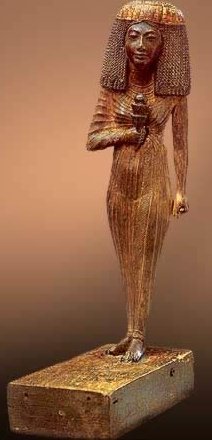
The wooden statuette represents Henut-Nakhtu who was a lady from the upper class during the New Kingdom, most specifically, at the end of the Eighteenth Dynasty (circa the end of the 14th century BC). Standing on a rectangular plinth, the wooden statuette was originally gilded and painted with lovely tones. We could identify the lady's name from Hieroglyphic inscriptions carved on the plinth, which include prayers to Henut-Nakhtu. The lady stands with her left leg advanced. Elegantly dressed, the woman wears a magnificent, long, transparent tunic decorated with thin stripes; and this garment leaves her left arm uncovered. She holds a bunch of flowers with her right hand; and a fragment with the left one. Hanging down from her smooth neck is an elaborate necklace consisting of three strings made of baguette and drop¬-shaped beads. Over her head, she wears an attractive wig with densely clustered ringlets topped by a golden crown decorated with lotus flowers. The overall appearance in which the beautiful lady is presented confers grace and value to the statuette.
Facts
- Material: Wood, Gilded and Painted
- Size: height 22.2 cm
- Found in: Saqqara , Giza, 1859
- Discovered by: A. Mariette
- Dynasty: 18th Dynasty
- Period: New Kingdom
- Museum: Egyptian Museum, Cairo
Related

Registration successfull!

Your Registration is successfully done
Please Check Your E-mail to Confirm Your Account. Do not forget to open the spam folder.
 EUR


 Español
 English
 العربيه


