Amulets in Ancient Egyptian Culture
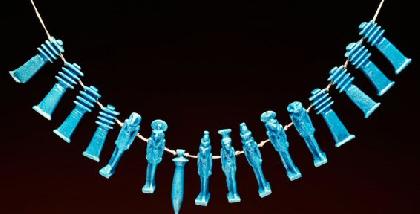
An amulet is an object that is either worn (usually as jewelry), carried (perhaps as a weapon), or put at a certain place with a ritual significance (such as a specific place within a home, or near a crop field). It was believed that it has magico-religious powers. Examples of such powers would include: the ability to protect against a specific type of danger, the ability to cure disease, or the ability to give preternatural strength to the wearer. Amulets started out in prehistory as found objects that seemed to be of special quality. Examples included animal parts (such as a tooth, an ear, a tail, or a foot) taken from a particular animal thought to have certain desirable traits associated with the purpose of the amulets. They could also be plants, herbs, or a mixture of herbs in a bag, tied or otherwise secured in place on a specific body part. Amulets could also come from the mineral world, as a stone of a particular shape or quality. Meteoric bits which are often magnetic, stones with natural holes in them, geodes, and crystals were all viewed as especially powerful. An amulet was basically a charm, often inscribed with a spell, magic incantation or symbol that protects the wearer against evil or provides aid and magical benefits. Amulets can aid or provide healing, luck or protection or even act as a double or replacement for an organ or limb.
There were several Ancient Egyptian words for amulets, most notably 'Sa' and 'Wedjau', which were associated with protection, well-being, and prosperity. A large variety of amulets were placed on the body and scattered among the wrappings to ensure the safety of the body and any easy passage into the Afterlife.Several of the spells in the Book of the Dead were intended to be spoken over specific amulets, which were then placed in particular places on the body of the deceased. A list of important funerary amulets from Ancient Egypt actually appears in the MacGregor papyrus. Both royal and non-royal individuals included amulets in their mummy bandages. King Tutankhamun had over 140 amulets scattered through his wrappings. The Book of the Dead specifically mentions certain amulets that have magical obligations to the deceased, notably the headrest and Wadj Pillar, which should be included with the mummy.
An amulet's power comes from its shape, material, and color. Green and blue stones, glass or faience signified resurrection and rebirth; hematite was used for amulets providing strength and support; carnelian, jasper, red glass or red faience were used for any amulet that symbolized blood, energy, strength, power and solar force. Although funerary amulets were important throughout Egyptian history, the type and number of amulets used changed over time. However, there were certain amulets that were fairly standard throughout the history of Egypt. Perhaps the best known Ancient Egyptian amulet is the Wedjat (or the 'Eye of Horus'). This amulet was supposed to represent the eye of god Horus or of god Re and protected the wearer against all evils by taking on the power of the god. Amulets representing the eye are found all over the body, interspersed with the wrappings.
More about Amulets in Ancient Egyptian Culture

Horus Amulet
Horus was the son of Osiris and Isis. He was the Falcon god and the 'Living God,' (the King) on earth. Horus amulet would have offered the...+
Read More
Isis Amulet
Isis was the protective mother goddess and is sometimes shown wearing the hieroglyph (st) or (aset), which means throne or seat adorning h...+
Read More
The Knot of Isis (Tyet Symbol)
Always made of red stone, the Knot of goddess Isis (also known as the Tyet Symbol) was a stylized representation of the goddess' genitals....+
Read More
Hathor Amulet
Like Isis, Hathor is a mother goddess who protected women and children. She was the goddess of the sky who nursed god Horus. Her name mean...+
Read More
Nephthys Amulet
Nephthys was the daughter of Geb and Nut, the sister, and helper, of Isis and Osiris and the sister-wife of Seth. She was thought to be a...+
Read More
Min Amulet
Min was the god of virility. His amulet shows him wrapped like a mummy with one hand raising a flail over his right shoulder and with two...+
Read More
The Amulet of Mut
As her name suggests, Mut is a vulture and mother goddess of Thebes. She is usually shown wearing a long brightly colored dress and a vult...+
Read More
The Amulet of Sopdu-Hor
God Sopdu-Hor wears a headdress of two falcon feathers and is associated with god Horus. The back pillar of his amulet is inscribed with h...+
Read More
Amulet of Ptah
The ancient creator god of Memphis, Ptah, was the patron of craftsmen. He is depicted wrapped like a mummy with skullcap and straight bear...+
Read More
Amulet of Nefertum
In the 'Pyramid Texts', Nefertum is the god of the lotus called 'The Lotus Blossom which is at the nose of Re' and he is also called the '...+
Read More
Thoth Amulet
Sometimes assuming the form of an ibis bird, god Thoth was the god of writing and scribe of the gods. Thoth was the 'God of the Equilibriu...+
Read More
Khnum Amulet
Khnum was a ram-headed god and is closely connected with the rise of the Nile, heralding life-bringing inundation. He is often shown creat...+
Read More
Sekhmet Amulet
Sekhmet, the lioness goddess, was the fierce goddess of the Memphite area. Her name means 'She who is powerful'. She was the wife of Ptah,...+
Read More
Bes Amulet
Bes, the god of children, dance and games, is a dwarf-like god with a lion's mane. He is always shown naked with bandy legs, wearing tall...+
Read More
Taweret Amulet
Taweret is the female hippopotamus goddess who is shown pregnant. She was thought to provide protection to women in the precarious occupat...+
Read More
Wedjat, Eye of Horus
Amulets were buried in and around the mummy bandages to provide it with protection against different types of potential dangers after deat...+
Read MoreMore Articles

 Login By Google
Registration successfull!

Your Registration is successfully done
Please Check Your E-mail to Confirm Your Account. Do not forget to open the spam folder.
 Español
 English
 العربيه