Statue of a Falcon (Sais , San El Hagar)
This statue of a falcon was found at Sais (San el Hagar) in 1893 and is one of the numerous statues of god Horus on display at the Egyptian Museum. In the Egyptian mythology, the falcon was highly revered being the bird representation of the god of the sky, Horus. The bird had always been identified with haughtiness, strength, and benevolence. His wings unfolded to stretch out throughout the sky with his eyes– which represented the sun and the moon– filled with pride, strictness, and serenity. The eyes of Horus the falcon also have a great significance. An Egyptian legend said that there had been a fight between Seth (brother of Osiris) and Horus because Seth had killed Horus´ father (Osiris). In this combat Seth had damaged Horus´ eyes. But the wise god Thoth healed Horus´ eyes and then he used one of the cured eyes to revive Osiris. Since that time the eye of Horus became a powerful healing amulet associated with protection and regeneration. Unsurprisingly, in the coronation of Egyptian Pharaohs included a celebration that symbolically identifies the king with the falcon god.
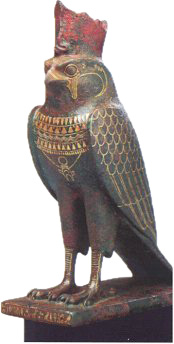
This statue is made of bronze and skillfully gilded with gold inlays. The plinth upon which this statue stands is inscribed with some Hieroglyphics saying that the statue was ordered by Imhotep, the son of Padineith and Iah. It was strongly believed that he who had his name inscribed on a statue placed at a temple magically attend the religious rituals, processions, and festivals that were daily performed there. Egyptians manufactured clay models and poured in them the metal to mold statues in the desired shapes. What a viewer first admire in the statue the air of haughtiness and grandeur it expresses. The falcon's talons are firmly set; its gaze confidently sharp; and its overall posture is of a fearless warrior. The small feathers highlighted in a golden color on his wings are outlined in minute detail with a great degree of accuracy. These wings are gracefully folded inwards with an air of loftiness and nobleness. The chest is decorated with several lines outlined with a golden color with geometrical patterns; all gather to form what resembles a fine Pharaonic collar of high taste. Down these stripes is a pectoral or a magical amulet in the shape of a heart with a sun disc. Further upwards, fine golden drawings outline the part lower to the sharp-sighted eyes. On the head, the falcon wears a red crown (partly damaged) adorned with a uraeus (symbol of protection against evil influences).
Facts
- Material: Bronze with Gold Inlays
- Size: height 22.5 cm
- Found in: Sais , San El Hagar, 1893
- Dynasty: 26th Dynasty
- Period: Late Period
- Museum: Egyptian Museum, Cairo
Related

Registration successfull!

Your Registration is successfully done
Please Check Your E-mail to Confirm Your Account. Do not forget to open the spam folder.
 EUR


 Español
 English
 العربيه


