Statue of Min
The statue of Min, god of fertility dates back to the Late Pharaonic Period, an era that extended from 664 to 525 BC. In Egyptian mythology, god Min was the god of fertility in the ancient Egyptian mythology that had been deified in several centers throughout Egypt including Koptos and Panopolis probably in the 20th dynasty. In the 11th dynasty he was worshiped as the god of vegetation and the god of fertility who was responsible for rainfall and some vignettes say that it was seen at the time of rainfall by the mortals. The common form of Min that is depicted in many tombs and temples through out Egypt is man with a flail in his hand and his pines erect and his head was usually topped with the plumes of Amun.
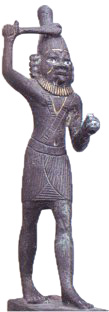
Although there are some Hieroglyphic writings on the statue's base identifying it with Min, this statue is highly controversial and there are some doubts whether or not it depict the god. This is because it can be identified as god Rashef, an Asiatic deity, from the short skirt and the cone-shaped headdress he wears as well as from the way he advances his left leg and raises his right arm. The statue can also be identified with god Bes (an Egyptian deity who was considered a protector of mothers and children). This association is stressed from the facial features of the statue that are similar to these of Bes.
Facts
- Material: Bronze
- Size: height 14.2 cm
- Dynasty: 26th Dynasty
- Period: Late Period
- Museum: Egyptian Museum, Cairo
Related

Registration successfull!

Your Registration is successfully done
Please Check Your E-mail to Confirm Your Account. Do not forget to open the spam folder.
 EUR


 Español
 English
 العربيه


