Statue of Hathor
This statue of Hathor dates back to the Saite Era (c 664-525 BC). It was gifted from King Fu'ad in 1936. Hathor was worshipped throughout the country; far away as Sinai and Nubia. In the Egyptian mythology, Hathor was presented as the goddess of love, music, dance, singing and beauty. Hathor was presented as the Earth mother who was called in the Coffin Text "the Primeval or the Lady of All". She was frequently depicted as a woman with a round face and holding a musical instrument in her hand. In some depictions, Hathor is presented as a cow and other times as a woman with the head of a cow and the striped three-part wig. Another attractive form of Hathor is the one where she is depicted as a complete woman with a couple of horns holding the solar disk between them over her head with her ears sticking out.
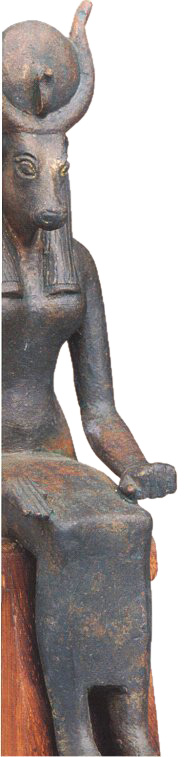
This statue depicts the goddess seated with a long garment wrapping her slender body and with her feet resting on a plinth. The well-preserved bronze statue measures 21 cm in height. With her two arms bending aside, her left fist is folded, probably once holding an ankh (an Egyptian symbol that represented the key of life). Her triple wig gracefully falls down her shoulders. With her wide ears sticking out, she has the face of a celestial cow with the typical broad nostrils and large eyes. Over her hear, she wears the huge solar disc resting on two cow horns. In the center of the horns, there is a uraeus serpent, symbol of protection against evil influences and malice.
Facts
- Material: Bronze
- Size: height 21 cm
- Found in: 1936
- Dynasty: 26th Dynasty
- Period: Late Period
- Museum: Egyptian Museum, Cairo
Related

Registration successfull!

Your Registration is successfully done
Please Check Your E-mail to Confirm Your Account. Do not forget to open the spam folder.
 EUR


 Español
 English
 العربيه


