Shawabty Container of Khonsu
Dating back to the Nineteenth Dynasty (1279-1212 BC), this shawabty container was found in the Tomb of Sennedjem in Deir al Medina. Shawabtis (also known as 'Ushawabtis') were funerary figurines placed in tombs among the grave goods and intended to act as substitutes for the deceased, should he/she be called upon to do manual labor in the afterlife. This case is made from wood lined with stucco then painted. It belongs to Khonsu who was a "servant in the House of Truth" and lived and worked in Deir al-Medina which was the settlement of the builders and craftsmen that undertook the construction works on the royal tombs in the Valley of the Kings.
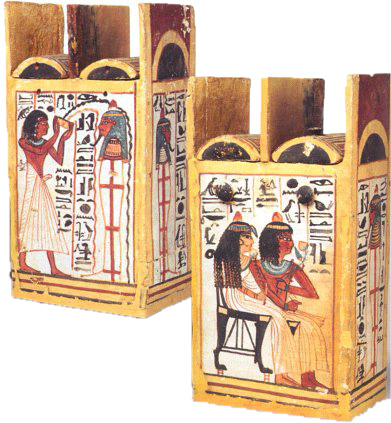
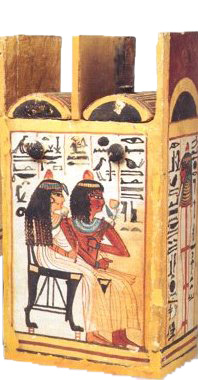
The Upper portion covering the case is modeled into two vaulted domes alternating with vertical panels. The four sides of the panels are embellished with realistically portrayed scenes in fine chromatic contrast depicting the deceased seated beside his wife. This is made more intense with the hieroglyphic texts outlined in black on the white backround with which the panels are painted. Also depicted is Khonsu posing as a mummified body totally wrapped in bandages and another scene pictures his daughter Nakhtmut purifying the body. Most admired is the everyday dress both the deceased and his wife are wearing: Khonsu wears an elaborate shendit-kilt (shendyt-kilt) that starts at his navel; while she wears an elegant tunic and a long-haired wig topped by a headdress.
Facts
- Material: Wood Lined with Stucco and Painted
- Size: height 35.6 cm, width 12.5 cm
- Found in: Tomb of Sennedjem in Deir Al Medina, in Luxor, 1886
- Discovered by: The Egyptian Antlquities Service
- Belonged to: Khonsu, son of Sen-nedjem
- Reign of: Ramsses II
- Dynasty: 19th Dynasty
- Museum: Egyptian Museum, Cairo
Related

Registration successfull!

Your Registration is successfully done
Please Check Your E-mail to Confirm Your Account. Do not forget to open the spam folder.
 EUR


 Español
 English
 العربيه


