Door of the Tomb of Sennedjem
This wooden door was found by G. Maspero in the untouched Tomb of Sennedjem in Deir al Medina, the settlement of the builders and craftsmen that undertook the construction works on the royal tombs in the Valley of the Kings. Found in 1886, it was identified to date back to the Nineteenth Dynasty, during the reign of King Ramesses II (1279-1212 BC). Sennedjem was one of the necropolis workers who were responsible for building and decorating royal underground tombs in the Valley of the Kings.
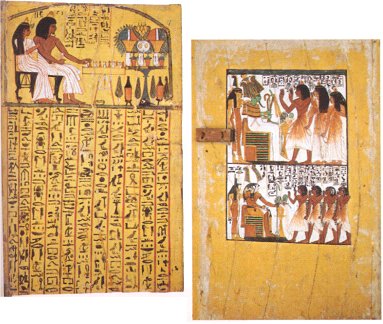
The kind of wood used in ancient Egypt was the sycamore wood, known as "nht" in hieroglyphics and considered to be a sacred material, as the goddess Hathor was the lady of the sycamore tree, or "nbt nht" in hieroglyphics. The tomb originally had a wooden door opening into the first small room. The door still bears the intact seal of the Theban necropolis. This seal is decorated with the image of the jackal-headed Anubis above nine prisoners.
It pictures a scene depicting Snnedjem and his wife, Iy-neferti playing the board game Senet (which symbolizes the deceased betting the destiny of his spirit, if he wins, it will survive). The game is spiritually connected with Chapter 17 of the Book of the Dead, and may represent the Judgment of Osiris. The scene ends with a table heaped with offerings and goods of all kinds for Sennedjem's sustenance.
As for the other face of the door, on the upper register, sennedjem is pictured standing with his wife "Iy-nefreti" and their daughters praying to "Osiris" and "Maat" seated on their throne.
On the lower part, the sons of Sennedjem are standing in front of god "Ra-hor-akhty" and "Isis", their names are "Khabekhnet, Bakhal, Rahotep, Khonsu, Ramsess, Antotep and Ranekhw.
Facts
- Material: Wood Lined with Stucco and Painted
- Size: height 135 cm, width 117 cm
- Found in: Tomb of Sennedjem, Deir Al-medina, 1886
- Discovered by: Gaston Maspero
- Belonged to: Sennedjem
- Reign of: Ramsses II
- Dynasty: 19th Dynasty
- Period: New Kingdom
- Museum: Egyptian Museum, Cairo
Related

Registration successfull!

Your Registration is successfully done
Please Check Your E-mail to Confirm Your Account. Do not forget to open the spam folder.
 EUR


 Español
 English
 العربيه


