Ceremonial Brazier Belonging to Rameses II
The bronze brazier was found by the French archeologist Pierre Montet in 1940 among a great corpus of gold and silver objects belonging to various pharaohs of different eras inside the Tomb of Psusennes I in Tanis. This piece dates back to the Nineteenth Dynasty and belongs to the great pharaoh Ramesses II (1279-1212 BC). Ramesses II was a very powerful and ambitious ruler who expanded Egypt’s empire a vast deal and constructed many temples all of which overshadow many of the others before him. He was known for his building structures and his plans of expansion. It was he who led the Battle of Kadesh (also Qadesh) which took place between the forces of the Egyptian Empire and the Hittite Empire under Muwatalli II.
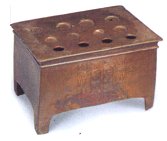
Made for the Sed Feslivals, the brazier takes the shape of a square box supported by short legs. This ceremony was held every four years to celebrate the revered occasion of the renewal of King's royal power. One side of the item is decorated with cartouches bearing the royal names of the Pharaoh. The inscriptions continue to record King Ramesses II adorning gods Ra-Harakhti and Ptah- Tatenen.
Facts
- Material: Bronze
- Size: height 24 cm, width 26.5 cm
- Found in: Tanis, Tomb of Psusennes I, Crypt of Psusennes I, 1940
- Discovered by: Pierre Montet
- Belonged to: Ramsses II
- Reign of: Ramsses II
- Dynasty: 19th Dynasty
- Period: New Kingdom
- Museum: Egyptian Museum, Cairo
Related

Registration successfull!

Your Registration is successfully done
Please Check Your E-mail to Confirm Your Account. Do not forget to open the spam folder.
 EUR


 Español
 English
 العربيه


