Plaque for the Mummy of Psusennes I
This stunning plaque was found by Pierre Montet in 1940 in the Tomb of Psusennes I in sepulcher of Psusennes I in Tanis. King Psusennes I was the third king of the Twenty-first Dynasty of Egypt who ruled between 1047 – 1001 BC. Measuring 16.6 cm in width and 9.9 cm in height, the gold piece was identified to date back to the Twenty-first Dynasty (994-985 BC). After all the steps of mummification were performed to the dead bodies and the mummy was wrapped with bandages, a plaque was placed on the cut that was made in the lower part of the stomach to remove the internal organs from the body with the liver, lungs, intestines, and stomach. The purpose of the plaque was to provide strength to the body to be protected at this vulnerable point.
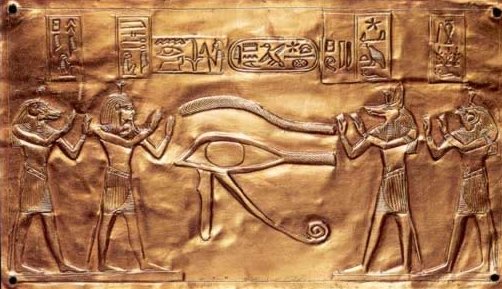
The plaque has a small engraved molding with four holes in the corners to fix it to the bandages of the mummy. Carved on the plaque is a very significant scene that provides deep conceptions and ushers to various complex beliefs from the ancient Egyptian mythology. It presents the Four Sons of Horus - Imset (Amset), Hapi, Duamutuef (Duamutef), and Qebehsenuef (Qebehsenuf) – wearing pleated skirts and the 'nemes' (Pharaonic headdress) on their heads attached with royal uraeus cobras. These figures are shown posing with the Wedjat Eye (also the Udjat, Wadjet, or the Eye of Horus) in the center. This eye was a symbol of protection against evil that provides a powerful healing power. Carved on the eye is an inscription that says: "To the Osiris King Psusennes meryamun."
Facts
- Material: Gold
- Size: height 9.9 cm, width 16.6 cm
- Found in: Tanis, Tomb of Psusennes I, 1940
- Discovered by: Pierre Montet
- Belonged to: Psusennes I
- Reign of: Psusennes I
- Dynasty: 21st Dynasty
- Period: Third Intermediate Period
- Museum: Egyptian Museum, Cairo
Related

Registration successfull!

Your Registration is successfully done
Please Check Your E-mail to Confirm Your Account. Do not forget to open the spam folder.
 EUR


 Español
 English
 العربيه


