Anklet Belonging to Psusennes I
This skillfully designed anklet was found by Pierre Montet in 1940 among the treasures in the Tomb of Psusennes I in sepulcher of Psusennes I in Tanis. King Psusennes I was the third king of the Twenty-first Dynasty of Egypt who ruled between 1047 – 1001 BC. This piece of jewel– made from gold, lapis lazuli, and carnelian– was identified to date back to the Twenty-first Dynasty (994-985 BC).
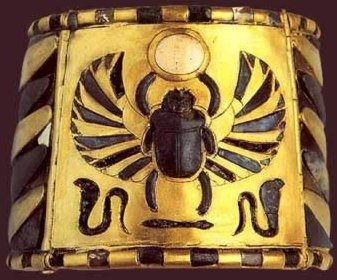
The upper and lower rims of this round anklet are made from small beads of lapis lazuli and gold. The piece is embellished in the center with a square panel from champlevé gold of high quality. This part is decorated with a winged scarab, one of the commonest motifs ornamenting jewels of ancient Egyptians who noticed that the female scarab lays its eggs in a ball of dung and rolls it to hide in a safe place. From this they observed new life emerging. Here, the scarab is presented pushing a sun disk with two uraeus serpents on either side. Between these cobras is a depiction of the hieroglyph (aa); and together with the other depiction, it forms the hieroglyphic group of the royal name of the King, namely 'Aakheperre'. From inside, the anklet has some hieroglyphic inscriptions that show a dedication by Smendes, who was the High Priest of Amun and the son of Menkheperre.
Facts
- Material: Gold, Lapis Lazuli, and Carnelian
- Size: height 5.5 cm, diameter 6.6 cm
- Found in: Tanis, Tomb of Psusennes I, Sepulcher of Psusennes I, 1940
- Discovered by: P. Montet
- Belonged to: Psusennes I
- Reign of: Psusennes I
- Dynasty: 21st Dynasty
- Period: Third Intermediate Period
- Museum: Egyptian Museum, Cairo
Related

Registration successfull!

Your Registration is successfully done
Please Check Your E-mail to Confirm Your Account. Do not forget to open the spam folder.
 EUR


 Español
 English
 العربيه


