Canopic Vases of Psusennes I
These four canopic jars were found among the treasures included in the Tomb of Psusennes I, in Tanis. Ancient Egyptians paid much attention to the preservation of the dead body's viscera. The manner of treatment each internal organ of the body received varied according to the Ancient Egyptians' perceptions of their significance. The brain was discarded, because its function was not understood. The heart was considered to be the physical "centre" of the individual and the location of the intelligence. The visceral packages were treated as miniature mummies, separately preserved and encased in containers. These vases, which have affinities with full-sized coffins, were usually made from alabaster, calcite, or terracotta.
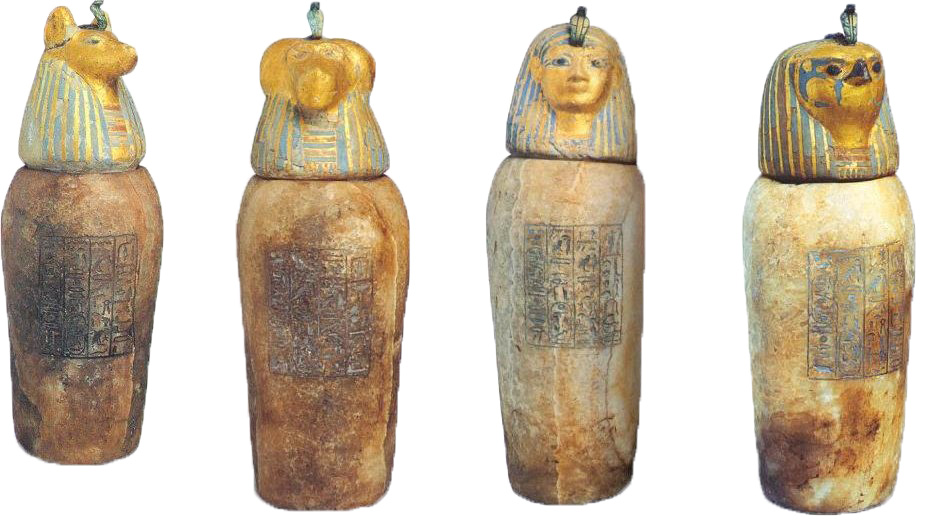
These vases are protected by the Four Sons of Horus (the human-headed Imset, dog-headed Duamutef, baboon-headed Hapi, and falcon-headed Qebehsenuf). The liver was protected by Amset; the stomach by Duamutef; the lungs by Hapi; and the intestines by Qebehsenuf. The lids are covered with a thin layer of gold leaf and glass paste topped by a uraeus serpent (a symbol of protection against evil influences). Each vase is decorated with hieroglyphics and invocation that protect it.
Facts
- Material: Alabaster and Gold Leaf
- Found in: Tanis, Tomb of Psusennes I, Crypt of Psusennes I, 1940
- Discovered by: Pierre Montet
- Belonged to: Psusennes I
- Reign of: Psusennes I
- Dynasty: 21st Dynasty
- Period: Third Intermediate Period
- Museum: Egyptian Museum, Cairo
Related

Registration successfull!

Your Registration is successfully done
Please Check Your E-mail to Confirm Your Account. Do not forget to open the spam folder.
 EUR


 Español
 English
 العربيه


