Wall Relief with Scenes of an Expedition to Punt
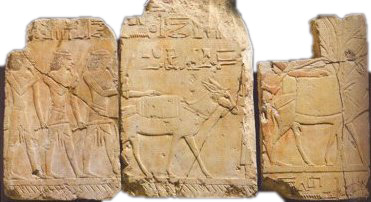
These two relief are the only remaining of a large number of depictions for the trading expedition made during the ninth year of Hatshepsut's reign (1479-1458BC) to punt, a region probably on the Somalian coast. They were discovered in the second terrace of Hatshepsut Temple in El Deir El Bahari.
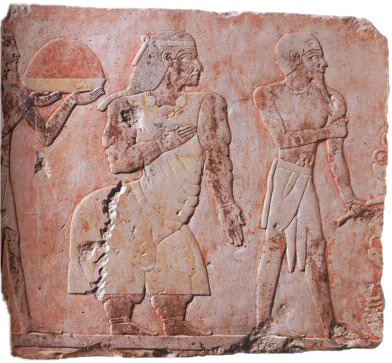
The bottom of the scene depicts a couple followed by one of their servants carrying some of the products of Punt: incense, myrrh, ivory, ebony, gold, malachite, and electrum. The man Parehu, King of Punt region on the Somalian Coast, as indicated in the hieroglyphic inscriptions appears as a very thine man with pointed beard. He wearing a necklace and short shendit with two tassel and a dagger in the waistband and followed by his wife. Parehu's his wife Ati is depicted as a very fat woman with numerous rolls of fats around her arms, legs and torso that are assumed to be caused a deceased that she was suffering from. She is dressed in a sleeveless dress, necklace with plain disks and anklets on both legs.
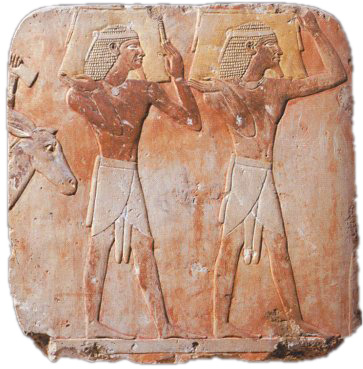
The other relief shows some of the workers carrying some goods and others urging donkey to move forward.
Facts
- Material: Painted Limestone
- Size: height 49.3 CM cm, width 45 CM cm
- Found in: Thebes,temple of Hatshepsut at Deir Al-bahari
- Belonged to: King Parehu
- Reign of: Hatshepsut
- Dynasty: 18th Dynasty
- Period: The New Kingdom
- Museum: Egyptian Museum, Cairo
Related

Registration successfull!

Your Registration is successfully done
Please Check Your E-mail to Confirm Your Account. Do not forget to open the spam folder.
 EUR


 Español
 English
 العربيه


