Third Sarcophagus of Hatshepsut
Hatshepsut was the daughter of Thutmosis I, the wife and successor of Thutmosis II and the mother of Princess Neferura. This head is a part of a complete statue for the queen was discovered in the portico of the third terrace of her temple at Deir al-Bahari. Hatshepsut had two tombs built for her, one at Deir El Bahari when she was still "the royal bride" and had not yet become regent and the other in the Valley of the Kings with the royal name of Maatkara.
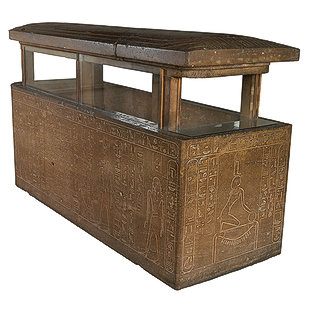
This sarcophagus is one of the three sarcophagi of Hatshepsut one of them was used for the burial of thutmosis I, now displayed in Boston. This sarcophagus is decorated with shallow relief figures of gods and the protective spirits of the deceased between columns of hieroglyphs. The most praiseworthy image decorating the sarcophagus is the rounded edge of the sarcophagus with nice decorations in the shape of cartouche. The sides of the sarcophagus are decorated with portrays for the deities including: the two udjat eyes symbolizing perfection and renewal, Nephthys holding the solar circle that represents protection, Neb crowned by a stylized palace, and many other deities. The base of the sarcophagus is decorated with Isis crouching on the hieroglyph for gold and holding the solar circle that represents protection. There are numerous hieroglyphic inscriptions some of them indicate the titles of the queen after assuming power including King of Upper and Lower Egypt and Daughter of Ra and other inscriptions for the names of the deities over the sarcophgus.
Facts
- Material: Red Sandstone
- Size: height 100 CM cm, width 87 CM cm
- Found in: Thebes, Valley of the Kings, Tomb of Hatshepsut, 1905
- Discovered by: H. Carter
- Belonged to: Hatshepsut
- Reign of: Hatshepsut
- Dynasty: 18th Dynasty
- Period: The New Kingdom
- Museum: Egyptian Museum, Cairo
Related

Registration successfull!

Your Registration is successfully done
Please Check Your E-mail to Confirm Your Account. Do not forget to open the spam folder.
 EUR


 Español
 English
 العربيه


