Sphinx of Hatshepsut
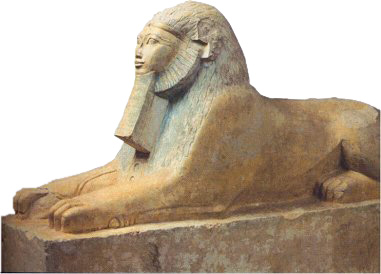
Hatshepsut was the daughter of Thutmosis I, the wife and successor of Thutmosis II and the mother of Princess Neferura. The sphinx of Hatshepsut was discovered in the Temple of Hatshepsut in Deir El Bahari. The sphinx is carved in the traditional way of ancient Egypt with the body of a powerful lion and the face of a human being as significance for the mighty and power of the king or the queen. Hatshepsut's Sphinx is remarkably used to depict the feline character of the queen that is accentuated by the large, square false beard that is described in the hieroglyphic inscriptions over the stone base of the statue as "Maatkara, beloved by Amun and endowed with life for eternity". The face of the queen is depicted in the traditional way with almond-shaped eyes with highly curved eyebrows, a slim nose, and a small, smiling mouth.
Facts
- Material: Painted Plaster
- Size: height 62 CM cm
- Found in: Deir Al-bahari, Temple of Hatshepsut, 1928-29
- Discovered by: The Metropolitan Museum of Art
- Belonged to: Hatshepsut
- Reign of: Hatshepsut
- Dynasty: 18th Dynasty
- Period: The New Kingdom
- Museum: Egyptian Museum, Cairo
Related

Registration successfull!

Your Registration is successfully done
Please Check Your E-mail to Confirm Your Account. Do not forget to open the spam folder.
 EUR


 Español
 English
 العربيه


