Statue of Isis-selket
The statue of Isis-selket was found while unearthing the rich archeological site of the Serapeum at Saqqara. Goddess Isis-Selket was a combination of Isis and the goddess-scorpion Selket (also spelt: Selchis, Selket, Selkis, Selkhit, Selkit, Selqet, Serkhet, Serket-hetyt, Serqet and Serquet). She was worshipped from the early first dynasties. She was frequently mentioned in the Pyramid Texts and her name means: "the one who causes the throat to breathe". She had the ability to heal stings and bites; and she was often said to protect the deities from Apep (Apophis ), the great snake-god of evil, sometimes being depicted as the guard when this snake was captured. She is usually depicted as a woman with a scorpion's head or as a lioness or serpent. Some mourning scenes depict the goddess crouching on her heels with her sister Nephthys near the death bed of her brother and husband, Osiris. Selket was responsible for watching over the royal coffin together with Isis, Nephthys and Neith. Together with Qebehsenuef (one of the four sons of Horus), Selket was the guardian of the falcon-headed canopic jar.
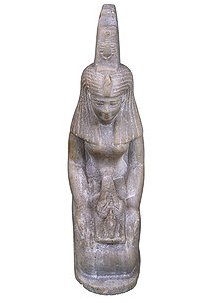
This statue of the goddess is made of fine grey alabaster. We could identify her identity from her distinct headdress and the scorpion ornament before the throne. She is seated on an oval base, with her hands bending down on her legs. Resting on her tights is a statuette of Osiris totally wrapped with bandages wearing the Atef Crown and holding the crook and flail. Over her head she wears a fine striped triple wig gracefully falling down her shoulder. Topping the headdress is a uraeus serpent. Worth appreciation is the skillful carving of the highly impressive facial expression of the beautiful goddess.
Facts
- Material: Grey Alabaster
- Size: height 18.8 cm
- Found in: Saqqara, Serapeum
- Museum: Egyptian Museum, Cairo
Related

Registration successfull!

Your Registration is successfully done
Please Check Your E-mail to Confirm Your Account. Do not forget to open the spam folder.
 EUR


 Español
 English
 العربيه


