Statue of Bastet
This statue of Bastet was found in 1914 in Kom Kibrit. In ancient Egypt, cats were highly respected, admired, and revered. Known as "Miw" in Egyptian, cats were not only Egyptians' favorite beasts but also their sacred deity. One of the most famous cat goddesses first revered by the ancient Egyptians was Bastet (also known as Bast, Pasch, and Ubasti). Bastet was a war goddess and the daughter of god Re, the sun god. Up until 1000 BC she was portrayed as a lioness. But in usual depiction, she is represented as a woman with the head of a domesticated cat. during the Middle Kingdom she is identified with" Hathor" goddess of joy, music, dancing and later with "Mut" wife of god "Amun". As a cat, she was connected with the moon and as a lioness she was associated with the sunlight. The cult of the goddess was centered in Bubastis (Tell Basta, the capital of the 18th Nome of Lower Egypt). The Aegis of Bastet was thought to ward off misfortune and ensure fertility.
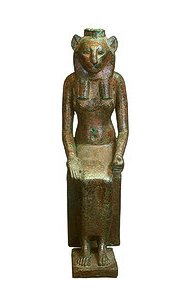
Measuring 42 in height, this bronze statue depicts the goddess enthroned with her feet resting on a plinth. She wears a long transparent tunic. Her two arms are folded on her legs with her left hand holding a scepter (now lost). With the head of a lioness, Bastet wears a triple wig falling down her shoulders. Over her head, there is a modius (crown) with a uraeus serpent on its front.
Facts
- Material: Bronze
- Size: height 42 cm
- Found in: Kom Kibrit, 1914
- Museum: Egyptian Museum, Cairo
Related

Registration successfull!

Your Registration is successfully done
Please Check Your E-mail to Confirm Your Account. Do not forget to open the spam folder.
 EUR


 Español
 English
 العربيه


