Nefertari at Abu Simbel: The Queen's Divine Depiction in Ramses II's Temple
Nefertari's Unique Status at Abu Simbel
The temple's façade shows her twice as the goddess Hathor, wearing cow horns and a solar disk, while Ramses appears four times with different crowns. Their children stand in diminished scale beside the royal couple's legs, emphasizing the primacy of the queen's divine association. This visual program declares Nefertari not merely as a consort but as a living manifestation of Hathor, the goddess of love, music, and maternal protection. The temple's dedication to "Hathor and Nefertari, Beloved of Mut" makes it one of the few Egyptian sanctuaries where a queen shares primary cultic focus with a major deity.
Who Was Nefertari
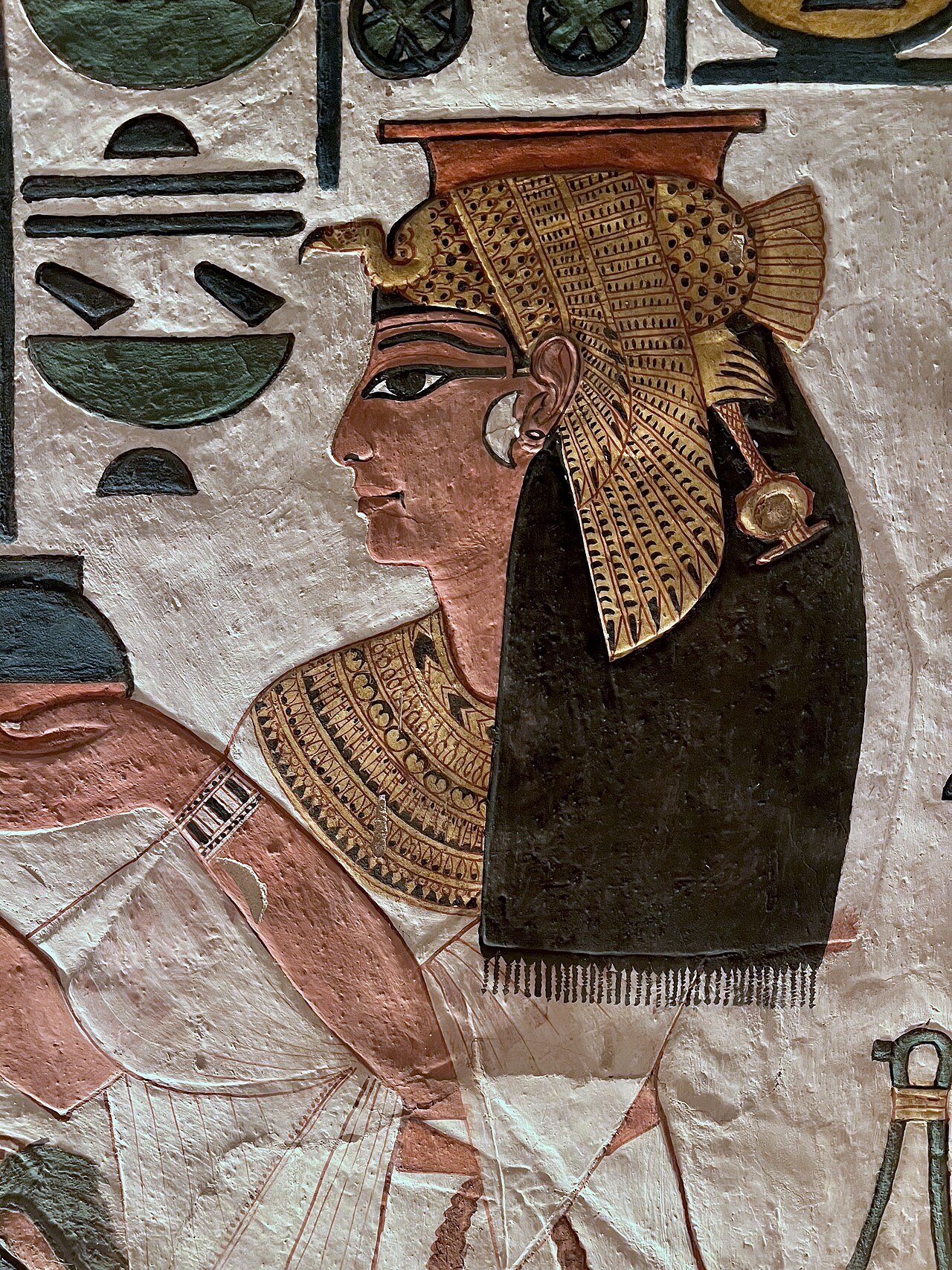
Nefertari, whose name means "The Most Beautiful of All" and "The Beloved of Mut," married Ramses II before his accession, becoming his friend, confidant, and mother of his eldest son. Her extensive titulary — Hereditary Noblewoman, Great of Favors, Possessor of Charm, Sweetness and Love, Mistress of Upper and Lower Egypt, King's Great Wife, Mistress of the Two Lands, Revered Before Osiris — reflects a status that transcended typical queenly roles. She accompanied the king on civil and religious ceremonies and major expeditions, functioning as a visible partner in the performance of kingship. Some scholars have proposed Nubian origins for Nefertari, which may have influenced the king's decision to honor her so prominently at Abu Simbel, a monument asserting Egyptian power in Nubia.
The Small Temple's Iconographic Program
The Small Temple's decoration systematically equates Nefertari with Hathor in her multiple aspects: as the celestial cow, the solar eye, the mistress of the west, and the goddess of intoxication and joy. Wall reliefs show Nefertari offering to Hathor and Mut, playing the sistrum, and receiving life and dominion from the gods — scenes that mirror the king's own ritual actions in the Great Temple. The sanctuary houses a statue group of Hathor as a cow protecting the king, with Nefertari's name inscribed on the base, fusing the queen's identity with the deity's protective embrace. This iconography served a political purpose: by presenting the queen as Hathor incarnate, Ramses II reinforced the legitimacy of his dynasty and the divine nature of his Nubian frontier policy. The temple's location at the southern border made this message visible to both Egyptian subjects and foreign neighbors.
Tomb QV 66 in the Valley of the Queens
Nefertari's tomb, designated QV 66, lies in the Valley of the Queens on the West Bank of Thebes, not the Valley of the Kings. Discovered by Ernesto Schiaparelli in 1904, it is celebrated for the exceptional quality and preservation of its wall paintings, which depict the queen's journey through the afterlife guided by deities including Isis, Nephthys, Hathor, and Osiris. The astronomical ceiling of the burial chamber represents the night sky with golden stars on a dark blue ground, while the pillars show Nefertari in the presence of gods, wearing the vulture headdress of a queen and the modius crown with uraei. The tomb's decorative program follows the Book of the Dead and other funerary texts, customized with the queen's specific titles and epithets. Although looted in antiquity, the surviving paintings demonstrate a mastery of color, composition, and anatomical rendering that ranks among the highest achievements of New Kingdom art. Conservation efforts in the late twentieth century stabilized the fragile plaster and pigment, allowing limited visitation under strict environmental controls.
Historical Significance and Legacy
Nefertari's prominence at Abu Simbel and the splendor of her tomb reflect a broader pattern in the early Nineteenth Dynasty, where royal women exercised visible influence in religion, diplomacy, and dynastic propaganda. Her depiction as Hathor at Abu Simbel established a precedent for the divine assimilation of queens that continued in later reigns. The temple's survival — relocated in the 1960s during the UNESCO salvage campaign to escape the rising waters of Lake Nasser — ensures that her image continues to dominate the Nubian landscape. Modern visitors encounter a queen whose husband chose to immortalize her not as a subordinate but as a divine partner, her face gazing eternally toward the rising sun. The combination of architectural scale, artistic refinement, and theological innovation makes Nefertari's Abu Simbel representation a singular case study in the public presentation of queenly power in ancient Egypt.
Visiting Abu Simbel Today
The Abu Simbel temples are accessible by air from Aswan or by road convoy through the desert. The Small Temple stands just north of the Great Temple, its façade framed by six colossi — four of Ramses II and two of Nefertari — each exceeding ten meters in height. Interior chambers retain much of their original painted decoration, though some pigment has faded. Photography is restricted inside to protect the artwork. The site includes a visitor center explaining the 1960s relocation project, which cut the temples into blocks and reassembled them on higher ground. Early morning visits offer the best light for viewing the façade reliefs and the interior Hathor columns. Guides typically highlight the queen's Hathor iconography, the royal children's figures, and the solar alignment phenomenon. The temples remain a focal point for understanding how Ramses II used monumental architecture to project royal ideology across Egypt's southern frontier.

Registration successfull!

Your Registration is successfully done
Please Check Your E-mail to Confirm Your Account. Do not forget to open the spam folder.
 EUR


 Español
 English
 العربيه


