Statuette of a Hedgehog
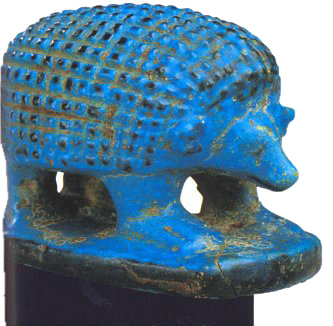
This statuette of a hedgehog was found in a necropolis in Thebes (present-day Luxor) and it was identified to date back to the Middle Kingdom (2065-1650 BC). Ancient Egyptian myths, hedgehogs appear both as admirable survivors and as steady, benevolent companions. In ancient Egypt, hedgehog amulets were worn to ward off snakebite. If approached by a snake, a hedgehog will bristle and roll up, fending off the reptile's striking fangs with its longer spines. When the snake is fatigued or wounded, the hedgehog attacks, biting along the backbone toward the head until the snake is dead. This animal was depicted on the bows of boats in tombs of the Old Kingdom as associated with Mut or Bes, the god of childbirth. Made of blue faience, this unique statuette measures 5.3 cm in height and 7 cm in length. Posing on an oval faience plinth, it has small eyes; a long nose; pointed ears; and a body totally covered with spines.
Facts
- Material: Blue Faience
- Size: height 5.3 cm
- Found in: Thebes
- Period: Middle Kingdom
- Museum: Egyptian Museum, Cairo
Related

Registration successfull!

Your Registration is successfully done
Please Check Your E-mail to Confirm Your Account. Do not forget to open the spam folder.
 EUR


 Español
 English
 العربيه


