Statues of Pepy I and Merenra
The statuary group of Pepi I and Merenra is regarded as a good example for copper statuary work in the Old Kingdom. It was found in the Temple of Horus in Hierakonopolis. It depict Pepi I who assumed power in the Sixth Dynasty (2289-2255 BC) and his heir Merenra. Some inscriptions on the tomb of the noble Uni the king announced his son Merenra to be his heir after he managed to abort the plot of one of his royal wives to assassinate him and put her son on the throne to avoid any other attempt for killing him.
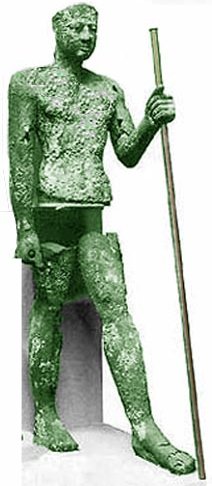
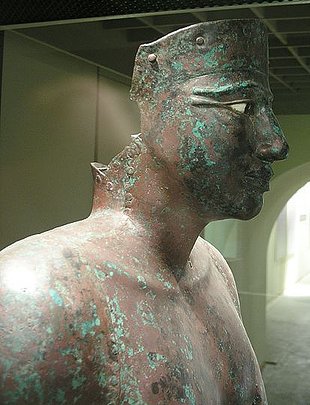
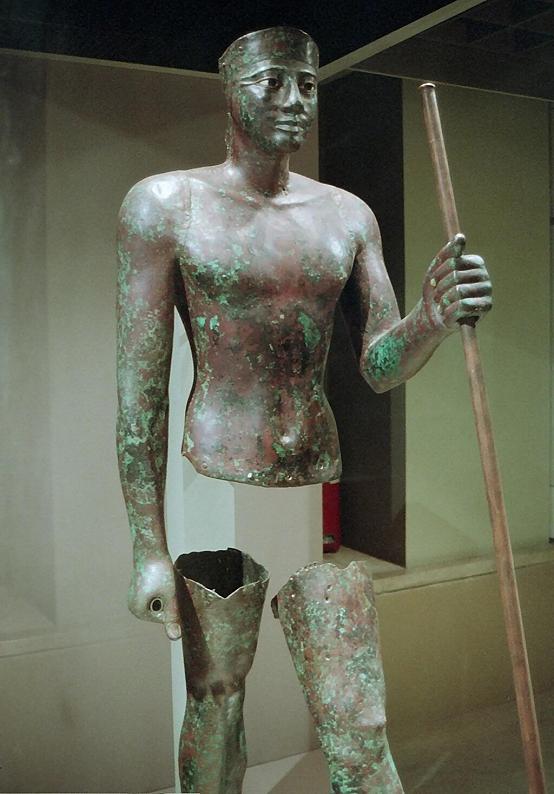
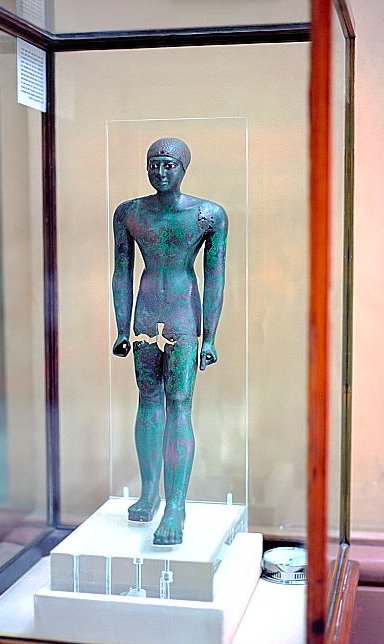
The statuary group consists of two statues one of them is believed to be for Pepi I while the other one might belong to his son Merenar. These statues are made of copper beaten over a wooden core and completed with several parts such as the king's crown, the uraeus serpent on Merenra's forehead, and the skins worn by both men. Worth mentioning that the priests dissembled the two statues and placed one of them within the other for storing them and sealed them with a copper piece with some carvings indicating the posts and titles of the king. The most attractive parts of these statues are the gold leaf on their toe-nails and the eyes inlaid with limestone and obsidian. Some Egyptologists negotiate that the second figure with Uraeus serpent on his forehead represents king Pepi I in his youth and that the statue was used as a representative for the deceased in the jubilee Ceremonies.
Facts
- Material: Bronze
- Size: height 177 CM cm
- Found in: Hierakonpolls, Temple of Horus, 1897-1898
- Discovered by: J. Quibell
- Belonged to: Pepi I
- Reign of: Pepy I
- Dynasty: 6th Dynasty
- Period: The Old Kingdom
- Museum: Egyptian Museum, Cairo
Related

Registration successfull!

Your Registration is successfully done
Please Check Your E-mail to Confirm Your Account. Do not forget to open the spam folder.
 EUR


 Español
 English
 العربيه


