Statue of Senusret I
Senusret I was the second king of the 12th Dynasty and heir of the throne after the assassination of his father, Amenemhet I. This yellow limestone statue of Senusret I was found in the funerary chamber of the Temple of Senusret I in Lisht among ten other statues for the king.
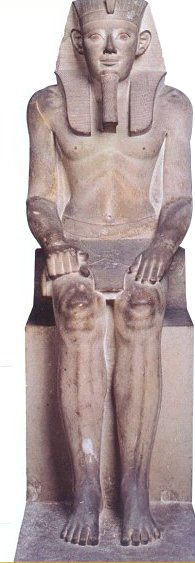
King Senusret is depicted setting on his throne with his hands on his legs with one of them folded and the other unfolded. As usual, the king is wearing a pleated shendit and putting a nemes headdress as a symbol for the power and majesty of the king and uraeus serpent on his forehead as a symbol for royalty.
The style and sculptor of this statue is typical to the one of AMenemhat III, his son, and both of them were designed to represent the king in the festival of rebirth of the king. The main characteristics of the Middle Kingdom sculpture is clear in that statue since the face of the king is captured in a way that reflect serenity to make him more human and the sculpture of the muscles and limbs is not as perfect and ideal as that of the Old Kingdom and this emanates a sense of absolute imperturbability.
Worth admiration in the seated statue of Senusret I is the relief of the sema-tauy motif ornamenting his solid throne from either sides. These carvings are used as a a representative for the unification of Upper and Lower Egypt and it is designed as the Nile god Hapi flanked with Papyrus and the lotus flowers, symbols for the two Egypts.
Facts
- Material: Yellow Limestone
- Size: height 200 CM cm
- Found in: El Lisht, Funerary Temple of Senusret I, 1894
- Discovered by: The French Institute of Oriental Archaeology
- Belonged to: Senusret I
- Reign of: Senusert I
- Dynasty: 12th Dynasty
- Period: The Middle Kingdom
- Museum: Egyptian Museum, Cairo
Related

Registration successfull!

Your Registration is successfully done
Please Check Your E-mail to Confirm Your Account. Do not forget to open the spam folder.
 EUR


 Español
 English
 العربيه


