Statue of Osiris (Saqqara, Serapeum)
Found in the Serapeum at Saqqara, this statue of god Osiris dates back to the 16th Dynasty, of the Second Intermediate Period. Osiris is on of the most famous ancient Egyptian gods who was considered the eldest son of Nut and Geb and the father of Horus the younger. He was regarded as the chief god of the underworld and revival who states the final judgment on the dead souls and Anubis was his assistant who was in charge of preparing the body before standing in the hands of Osiris. The people believed that he has the power of resurrection and fertility and that the Nile is his deathbed. There are a lot of information about Osiris way of treating the recently dead souls in the Book of the Dead, the Coffin Texts, and the Pyramid Texts. Osiris is described in the Book of the Dead as the lord of immortality, the heir of the North and South of the earth, the prince of gods and humans, and the Lord of Mendes and ruler in Abydos. Osiris was assassinated by his brother Seth who was jealous of him because of his great power that enables him to serve the mortal humans and grow the grains. Seth put the body of Osiris in a coffin and sent it away. After a long journey of suffer, Isis managed to find Osiris' body but Seth cut the body into pieces and thrown each one in an area of the earth. After gathering the body by the help of Thuth and Anubis, Isis wrapped him in the Mummy's clothes. When Horus, Osiris' son, grew up he took his revenge and put an end for his uncle's viciousness.
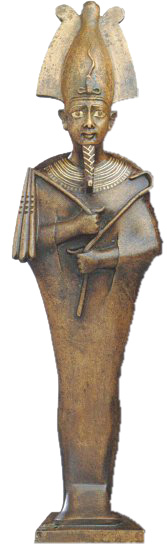
Made of bronze encrusted with gold and silver, this particular statue, standing on a base, depicts the god wrapped with bandages with his hands holding the royal crook and flail. The false beard fastened to its chin grants the statue an air of grandeur with a few harmonious stripes decorating its front. The facial expressions of the statue are excessively impressive. Although the statue has large eyes encrusted with silver and golden highlights, there is look of misery or weariness on its face. On his head, the statue wears Atef Crown with a uraeus fastened on its front (the uraeus was thought to provide protection against evil influences).
Facts
- Material: Bronze Encrusted with Gold and Silver
- Size: height 29.2 cm
- Found in: Saqqara, Serapeum
- Dynasty: 16th Dynasty
- Museum: Egyptian Museum, Cairo
Related

Registration successfull!

Your Registration is successfully done
Please Check Your E-mail to Confirm Your Account. Do not forget to open the spam folder.
 EUR


 Español
 English
 العربيه


