Shawabty Belonging to Ptahmes
This shabti was found in Abydos near a number of chapels built during the Middle Kingdom and was identified to date back to the Eighteenth Dynasty, more specifically, to the reign of Amenhotep III (1387-1350 BC). Shawabtis (also Ushabtis) were funerary figurines placed in tombs among the grave goods and intended to act as substitutes for the deceased, should he/she be called upon to do manual labor in the fields of the Land in the afterlife. This is suggested from the name 'usheb' which means 'respond'.
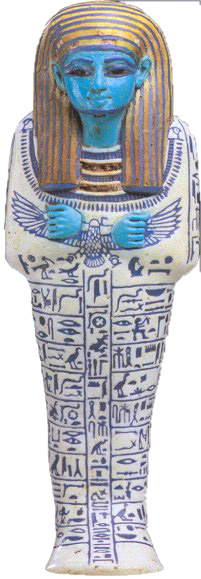
Made from polychrome faience, this example of shabtis belongs to Ptahmes, the vizier, mayor, and high priest in the Temple of Amun at Thebes under the reign of Amenhotep III. It is totally wrapped with bandages leaving the two fists visible. He wears a triple wig, striped with yellow and blue lines. On his chest, appears a depiction of goddess Nekhbet the vulture with her wings widely spread as a symbol of protection. Decorating the body are horizontal lines of spells and prayers in hieroglyphics from Chapter 6 of the Book of the Dead intersected by on vertical row—all outlined with blue over the white background. On this vertical line appear the names and titles given to Ptahmes. Hanging down from the smooth neck is a broad shoulder-to-shoulder collar fastened at either side by clasps with heads of Horus.
Facts
- Material: Polychrome Faience
- Size: height 20 cm, width 6 cm
- Found in: Abydos, 1881
- Discovered by: A. Mariette
- Belonged to: Ptahmes
- Reign of: Amenhotep Iii
- Dynasty: 18th Dynasty
- Period: New Kingdom
- Museum: Egyptian Museum, Cairo
Related

Registration successfull!

Your Registration is successfully done
Please Check Your E-mail to Confirm Your Account. Do not forget to open the spam folder.
 EUR


 Español
 English
 العربيه


