Pendant in the Form of the Head of Hathor
This stunning pendant was found in the Tomb of Sheshonq in Mit Rahina (Memphis) by the famous archeologist, Alexander Badawy in 1942. Hathor was worshiped throughout the country; far away as Sinai and Nubia. In the Egyptian mythology, Hathor was presented as the goddess of love, music, dance, singing and beauty. Hathor was presented as the Earth mother who was called in the Coffin Text "the Primeval or the Lady of All". She was frequently depicted as a woman with a round face and holding a musical instrument in her hand. In some depictions, Hathor is presented as a cow and other times as a woman with the head of a cow and the striped three-part wig. Another attractive form of Hathor is the one where she is depicted as a complete woman with a couple of horns holding the solar disk between them over her head with her ears sticking out.
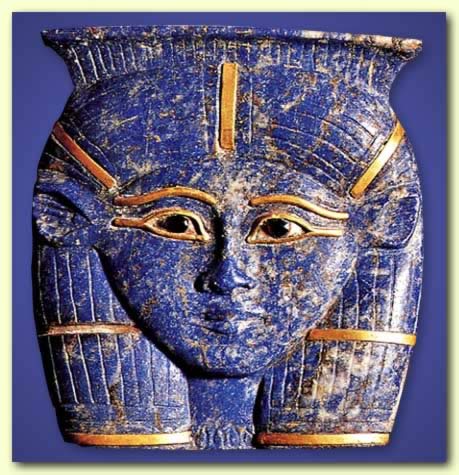
Embellished with thin gold sheets, this lapis lazuli pendant depicts the head of goddess wearing a striped triple wig gracefully falling down her shoulders. With her wide ears sticking out, she has the face of a celestial cow with the typical broad nostrils and large eyes. She gives a faint smile with her graceful lips. The beauty of her eyes and eyebrows are highlighted with the thin gold sheets applied to them. This is further strengthened with the contrast made by the fine chromatic contrast between the color of the eyes' eyeballs and background. Over her hair, she wears a simple flared modius.
Facts
- Material: Gold and Lapis Lazuli
- Size: height 5.5 cm, width 5.3 cm
- Found in: Mit Raihina ( Memphis ), 1942
- Discovered by: Alexander Badawy
- Belonged to: Sheshonq I
- Reign of: Osorkon II
- Dynasty: 22nd Dynasty
- Period: Third Intermediate Period
- Museum: Egyptian Museum, Cairo
Related

Registration successfull!

Your Registration is successfully done
Please Check Your E-mail to Confirm Your Account. Do not forget to open the spam folder.
 EUR


 Español
 English
 العربيه


