Mummy of Sety I
Found by the Egyptian Antiquities Service in l881, this mummy belongs to Pharaoh Sety I (Seti I), the second king of the Nineteenth Dynasty who met his death in 1279 BC. Depending on the realization that every thing after death came to life again, the Ancient Egyptians hold the belief that there is a life after death and therefore the mummification of dead bodies was inevitable. Notably, mummification symbolizes the fear of the Ancient Egyptians had of death and answers their eager desire for immortality. Such elaborate burial practices of Ancient Egyptians suggest that the Egyptians began early to make plans for their death out of their great love of life.
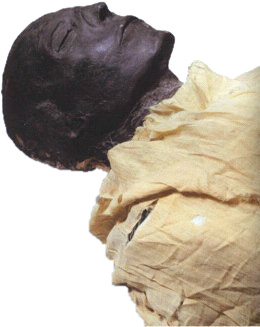
The mummy of Pharaoh Sety I was found in the cachette at Deir al-Bahari, in Luxor. At the end of the Twentieth Dynasty, the royal necropolises in the Valley of the Kings were no longer the burial places of the pharaohs. This was because with the increase of tomb robberies, it was much safer to the bodies of the deceased kings to be placed hidden in the cachette at Deir al-Bahari (DB 320) or in the tomb of Amenhotep II in the Valley of the Kings. Sety I must be credited with the great amount of restoration of the traditional temples, continuing the efforts of his predecessors. Everywhere, inscriptions of pre-Amarna pharaohs were restored, and the names and representations of Amun hacked out by Akhenaten were re-carved. He also started his own building program: in the great religious centers of Thebes, Abydos, Memphis, and Heliopolis, new temples were erected and existing ones expanded. Among the latter was the Temple of Seth at Avaris, a city that was soon to become the new Delta residence of the Ramesside rulers. At Karnak, Sety continued the construction of the Great Hypostyle Hall begun by Horemheb. The King's original burial place (KV 17) is one of the most luxurious tombs in the Valley of the Kings. His tomb was discovered in 1817by the Italian archeologist Belzoni after the name of whom the tomb was called.
Facts
- Material: Mummy
- Found in: The Cachette in Deir Al-baiiari (db 320), 1881
- Discovered by: The Egyptian Antlquities Service
- Belonged to: Sety I
- Reign of: Seti I
- Dynasty: 19th Dynasty
- Period: New Kingdom
- Museum: Egyptian Museum, Cairo
Related

Registration successfull!

Your Registration is successfully done
Please Check Your E-mail to Confirm Your Account. Do not forget to open the spam folder.
 EUR


 Español
 English
 العربيه


