False Door Stela of Ika
The false door was an essential part of the tombs of ancient Egyptians that was regarded as the point of contact between the hereafter world of the dead and the living world and in front of which the offerings intended to sustain the dead in the Afterlife were placed.
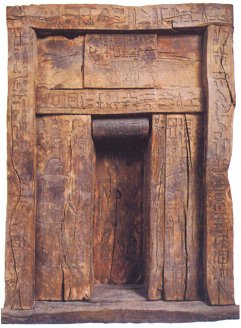
The traditional structure of the false door is a door with a central aperture topped by a cylinder in imitation of a rolled up piece of matting. This unique false door of Ika is made of 14 separate pieces of wood that were assembled and fastened together with wooden nails and leather thongs. Two side panels are framed by uprights and architraves and the upper part of the funerary niche portrays Ika, the deceased, with his wife as they "took possession" of the offerings that lay on the table and are listed in the text. The titles that the deceased held during his life including "Wab priest", i.e. "pure priest" and "Governor of the Great House" are engraved on the door. The doorjambs of the door is decorated with the figure of Ika's wife, Iymerit, a priestess of Hathor with her daughter Tjentet smelling a lotus flower whose perfume gave eternal life. Additionally, the two brothers hold their father's emblems as though they were being handed down from father to sons.
Facts
- Material: Wood
- Size: height 200 cm cm, width 150 cm cm
- Found in: Saqqara, 1939
- Discovered by: The Egyptian Antlquities Service
- Belonged to: Ika
- Dynasty: 5th Dynasty
- Period: The Old Kingdom
- Museum: Egyptian Museum, Cairo
Related

Registration successfull!

Your Registration is successfully done
Please Check Your E-mail to Confirm Your Account. Do not forget to open the spam folder.
 EUR


 Español
 English
 العربيه


