Tiles with Pictures of Prisoners
In 1910, excavations by the Egyptian Antiquities Service had found these tiles in the royal palace annexed to the funerary Temple of Ramesses III, the Temple of Medinet Habu in Luxor. They were discovered paving the floor near a window of a court in the temple. Ramses III, the second king of the Twentieth Dynasty, inherited peace and stability from his father, Sethnakht, but soon he had his share of troubles as well. In the fifth year, he had to fight off further advances by Libyan tribes, who had used the period of internal struggle to penetrate into the Western Delta. By this time, the Egyptians appear to have accepted this peaceful immigration as inevitable, but when a revolt against the pharaoh broke out because he interfered in the succession of their king, Ramses III quickly responded and brought them back under Egyptian control. Things were made worse by repeated raids by groups of Libyan nomads in the Theban area. The gradual breakdown of the centralized state may well have been one of the reasons behind an attempt on the life of Ramses III.
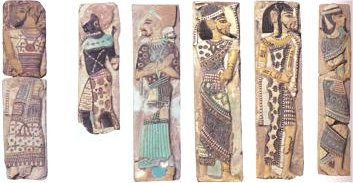
With a maximum height of 26 cm and a maximum width of 7 cm, these multi-colored were made from faience. They are decorated with images of a number of chained prisoners including, from left to right: a Bedouin, a Nubian, another Bedouin, a Syrian prince with a pointed beard, a Libyan with a side braid and tattoos, an Asiatic prisoner, a Hittite with long hair, and two more Asiatic and Libyan prisoners.
Facts
- Material: Polychrome Faience
- Found in: Medinet Habu, Palace Of Rameses Iii, 1910
- Discovered by: The Egyptian Antlquities Service
- Belonged to: Ramsses Iii
- Reign of: Ramsses Iii
- Dynasty: 20th Dynasty
- Period: New Kingdom
- Museum: Egyptian Museum, Cairo
Related

Registration successfull!

Your Registration is successfully done
Please Check Your E-mail to Confirm Your Account. Do not forget to open the spam folder.
 EUR


 Español
 English
 العربيه


