Stela of Merenptah Victory
The stela was discovered in the Temple of Merenptah, successor of Ramsses III, which was constructed using parts from the destroyed the temple of Amenhotep III. It was established to celebrate the king's victory in the fifth year of his reign against the invasion of the coalition between the Libyan people and "Sea Peoples"; Libu, Meshuesh, and other Indo-European peoples from Anatolia and the islands of the Aegean.
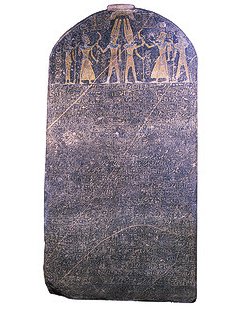
The stela encloses some hieroglyphic inscriptions indicating that Merenptah managed to defeat these troops and captured a large number of them. There are two engraved scentes indicating the pharaoh wearing ceremonial dress and offers Amun-Ra the reaping hook that symbolizes victory and the scepters of royalty. In one of these scenes, Merenptah is followed by the the goddess Mut and in the other by the god Khonsu, members of the Theban triad of gods with Amunra.
This stela is known as the "Stela of Israel" because it contains the only known reference to Israel in Egyptian sources. The name is mentioned with other names of troops that were defeated by the pharaoh including Gezer, Canaan, Yenoam, and Syria but in fact the king had not undertaken any military action in Asia and these names might have been only cited as a deterrent against those countries. Moreover "Israel" in this fragment does not refer to any place, but is used to refer to a group of people.
Facts
- Material: Granitic Rock
- Size: height 318 CM cm, width 163 CM cm
- Found in: Thebes, Temple of the Millions of Years, 1896
- Discovered by: W.m.f Petrie
- Belonged to: Merenptah
- Reign of: Merenptah
- Period: The New Kingdom
- Museum: Egyptian Museum, Cairo
Related

Registration successfull!

Your Registration is successfully done
Please Check Your E-mail to Confirm Your Account. Do not forget to open the spam folder.
 EUR


 Español
 English
 العربيه


