Statuette of a Hippopotamus
This unique statuette represents a blue hippopotamus found in the Necropolis of Dra Abu el Naga, in Thebes (present-day Luxor). Excavated in 1860 by A. Mariette, this figurine was identified to date back to the Second Intermediate Period (1781-1550 BC). Images and paintings for the hippopotamus were found decorating walls of tombs in ancient Egypt, symbolizing Tausret (Taweret), the goddess of fertility who appears frequently with god Bes protecting pregnancy, childbirth, and households. For this reason, people at the Middle Kingdom and Second Intermediate Period made sure they include statuettes for the figure at their burial place; but with the reign of Kamosis (the last ruler of the Seventeenth Dynasty) such figures were not included among the grave goods.
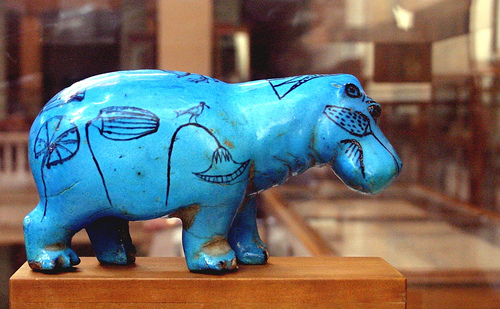
Made from blue faience, this example of the goddess is decorated with botanical drawings of flowers, aquatic plants, and birds—all outlined in black. Likewise, the eyes, mouth, ears are sketched with a black color, exposing a degree of simple, chromatic contrast.
Facts
- Material: Blue Faience
- Size: height 11.5 cm
- Found in: Necropolis of Dra Abu Al-naga , Thebes , Present-day Luxor, 1860
- Discovered by: A. Mariette
- Period: Second Intermediate Period
- Museum: Egyptian Museum, Cairo
Related

Registration successfull!

Your Registration is successfully done
Please Check Your E-mail to Confirm Your Account. Do not forget to open the spam folder.
 EUR


 Español
 English
 العربيه


